



How to Build a Healthcare CRM System: 9 Steps and Tips for 2026

Healthcare providers now hold more patient data than at any point in the industry's history. The real question is what to do with it. A well-built CRM turns scattered records, messages, and appointment histories into one coherent view of every patient relationship. Off-the-shelf tools rarely fit a clinic's exact workflow. That's why many providers turn to custom healthcare CRM development instead, usually as part of a wider healthcare software development services engagement rather than a standalone build. This guide covers what a 2026-ready system needs and the nine steps to build one.
What is healthcare CRM software?
Healthcare CRM software helps providers manage patient relationships, not just patient charts. It stores contact history, tracks communication preferences, and coordinates outreach across a care team. Ask what is CRM in healthcare and the answer is simpler than the acronym suggests. The CRM meaning healthcare teams work with comes down to a system built around consent rules and referral workflows. It carries the compliance obligations that come with handling clinical data, not a general-purpose sales tool with a medical logo bolted on.
EHR vs CRM: what's the difference in healthcare?
Two acronyms get confused constantly: EHR and CRM. They sit close to the patient record, but they solve different problems.
EHR | CRM | |
Core purpose | Clinical documentation and treatment history | Patient relationship management and engagement |
Primary users | Clinicians, nurses, care teams | Front-desk staff, marketing, patient services |
Typical scope | Single organisation (hospital, clinic) | Cross-organisation (referrals, payers, marketing) |
Example data | Diagnoses, medications, and lab results | Appointment history, communication logs, referral source |
The two systems increasingly talk to each other. Most healthcare CRM development projects now include at least a read connection into the EHR, often through the HL7 FHIR API standard. That way, a patient's engagement history and clinical record don't sit in two disconnected silos. For a deeper look at the clinical side, our guide to EHR system development covers the build in full.
Types of CRM software used in healthcare
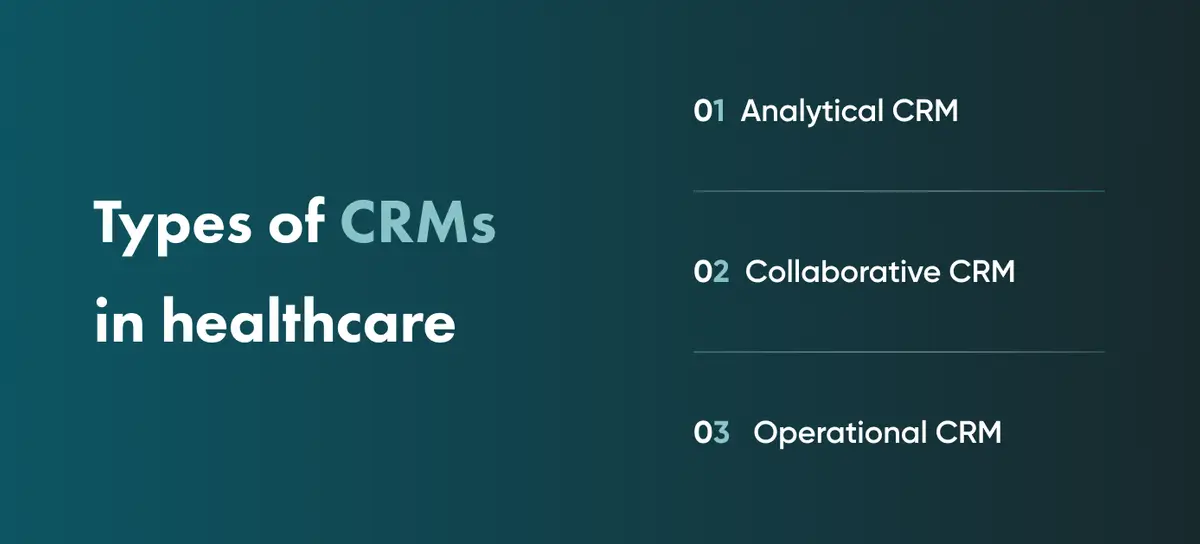
Not every healthcare CRM development project needs the same architecture. Three categories cover most real-world builds.
Analytical CRM
An analytical CRM turns patient data into patterns. Which age group misses the most appointments? Which outreach channel actually gets a response? Salesforce Health Cloud Analytics and IBM Watson Health are common examples on the market today, and both exist because someone got tired of guessing.
Collaborative CRM
A collaborative CRM focuses on communication between providers, patients, and stakeholders such as insurers or referring physicians. It keeps care coordination visible across teams instead of being buried in separate inboxes.
Operational CRM
This is the workhorse category. An operational CRM automates the daily mechanics: scheduling, billing, and patient management. Most clinics reach for this type first, and for good reason. A custom build usually pays for itself fastest here, since these are the workflows with the most repetitive manual work, the kind nobody enjoys doing by hand.
Why healthcare organisations are investing in CRM in 2026
Healthcare CRM solutions used to be a nice-to-have. That's no longer true. Staffing shortages, rising patient expectations, and a wave of AI-assisted tools have pushed CRM for healthcare providers from optional to close to essential.
Most clinics still run patient outreach through spreadsheets and reminder calls squeezed between appointments.
That gap is exactly where a CRM earns its cost back.
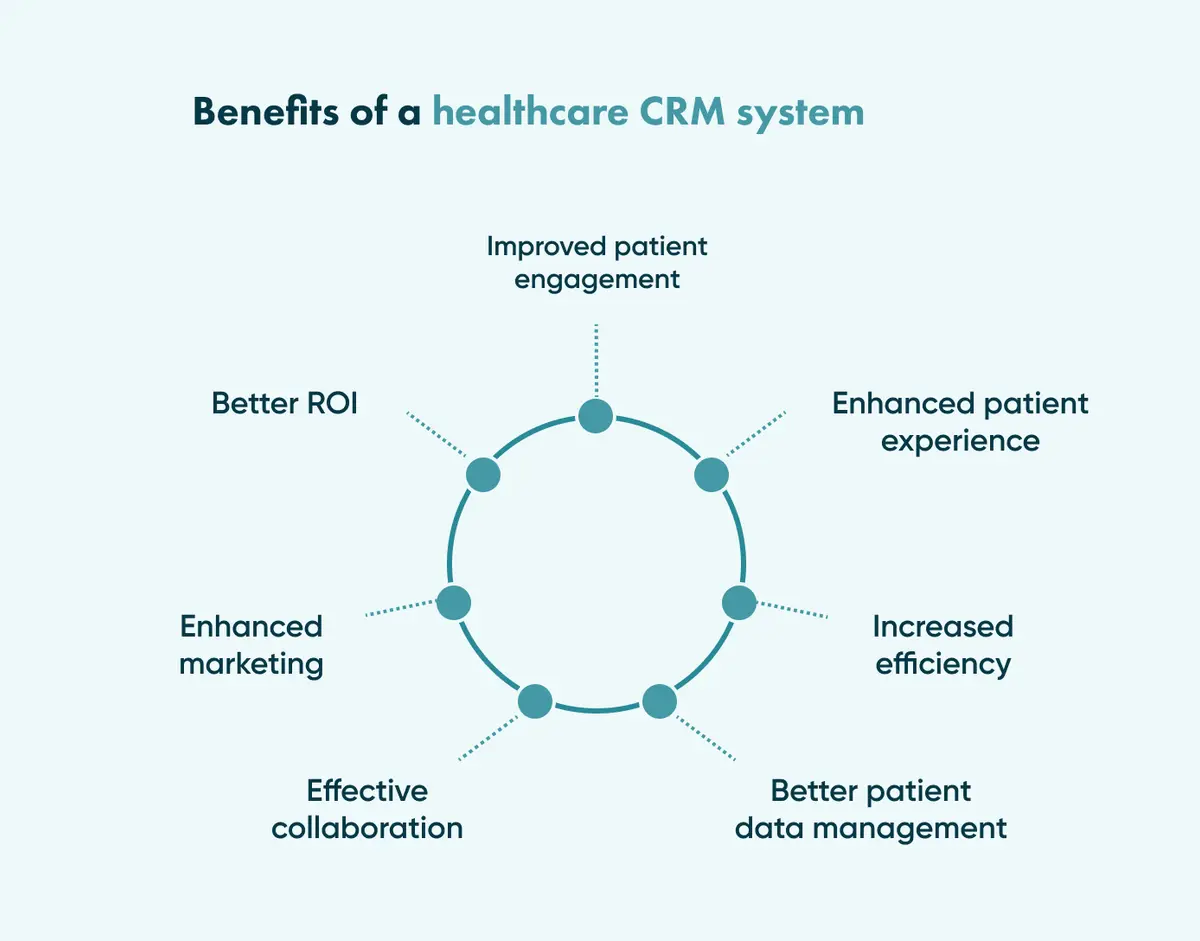
Better patient engagement
Personalised reminders, follow-up messages, and consistent communication keep patients on treatment plans instead of drifting away between visits.
AI-assisted outreach and scheduling
This is where 2026 looks different from even two years ago. Salesforce rolled out Agentforce for Health, giving care teams AI agents that can match patients with in-network providers, handle scheduling, and manage benefits verification without a human touching every step. Rush University System for Health and hearing-care provider Amplifon are both using the platform to cut administrative load and free staff for direct patient contact. It's part of a broader pattern we've tracked in AI in Healthcare: A Revolution for the Medical Industry: AI is moving from pilot projects into everyday clinical operations. Building this kind of capability into a custom system typically draws on the same AI services and solutions used across other automation projects.
Reduced administrative overhead
Automating scheduling, billing, and routine communication frees staff for care instead of data entry. This is one of the clearest wins from business process automation applied to a clinical setting.
Better data for decisions
A CRM paired with proper BI and data visualisation gives administrators a real view of patient behaviour, not a guess based on last quarter's spreadsheet.
Stronger collaboration across the care team
Referrals, care gaps, and visit summaries become visible to everyone who needs them, rather than living in one person's inbox.
Improved marketing ROI
Data-driven outreach means fewer wasted messages and a clearer picture of which campaigns actually bring patients in.
Core features every 2026 healthcare CRM needs
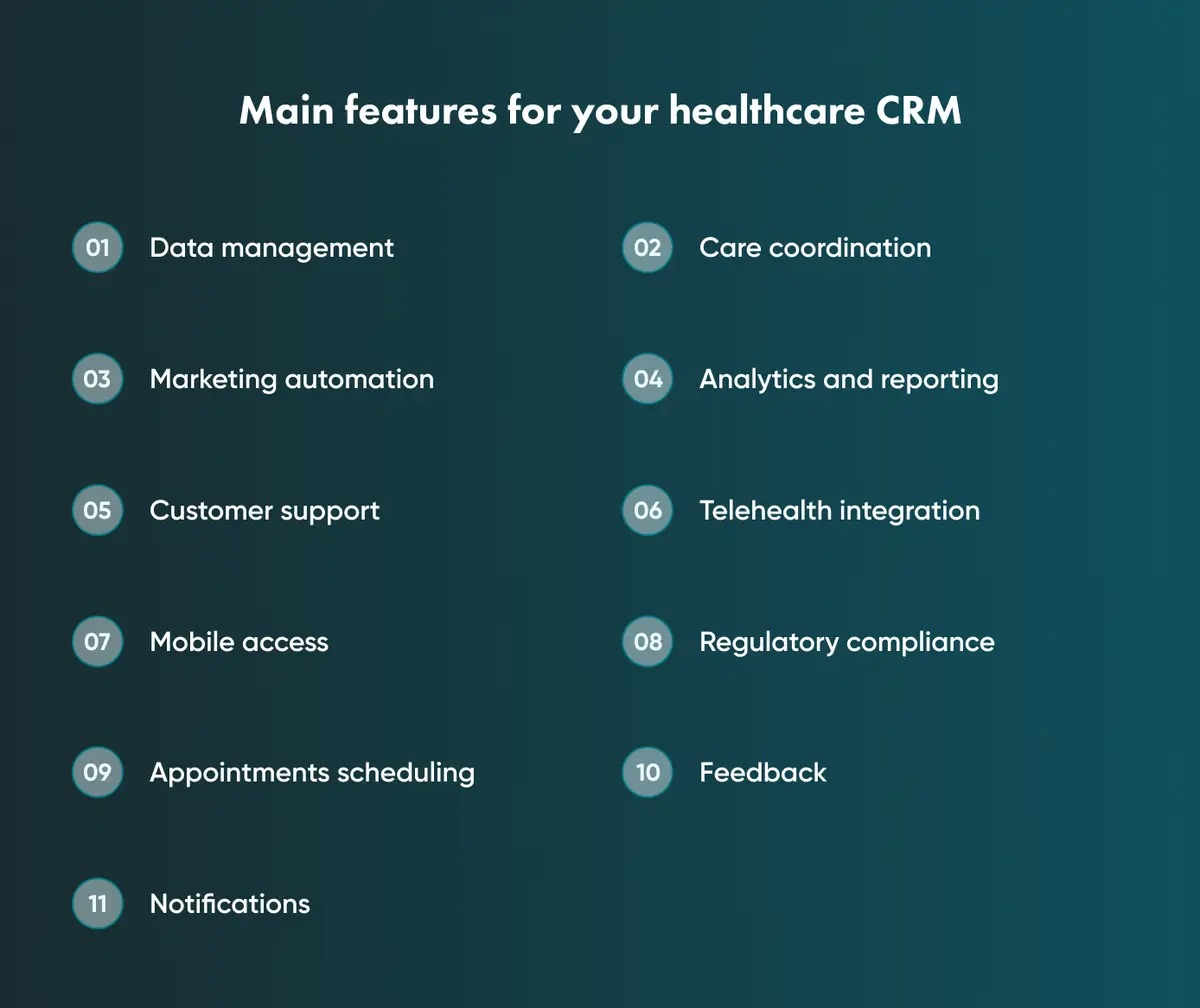
The healthcare CRM features that mattered five years ago are the baseline now, not the differentiator. Any healthcare CRM development project in 2026 needs to plan for more than a contact list. Here's what belongs in a build today.
Patient data management
At its core, this is a robust record of patient information, appointments, treatments, and communication history. Keep it separate from clinical documentation. Link the two together anyway.
Care coordination
Tools that support communication and information sharing across a care team, so a referral or a care gap doesn't disappear between departments. Most teams don't notice this feature until the day it's missing and a referral falls through the cracks.
AI-assisted patient engagement
Predictive outreach that flags no-show risk, personalises reminders, and, increasingly, hands routine scheduling questions to an AI agent rather than a call centre queue.
FHIR-based interoperability
Here's the part vendors won't volunteer. By July 2026, the Trusted Exchange Framework and Common Agreement (TEFCA) requires participating networks to support FHIR-based queries, not just older document exchange. A CRM built without this in mind will be playing catch-up within the year.
Marketing automation
Lead tracking, email campaigns, and social integration. Aimed at growth, not day-to-day patient care, and worth keeping separate in the architecture for that reason.
Analytics and reporting
The reporting layer that turns raw interaction data into decisions healthcare providers can actually act on, rather than a dashboard nobody opens after week two.
Telehealth integration
A direct line into video consultation tools, so a virtual visit updates the same record as an in-person one.
Mobile access
Staff need to check schedules and patient notes from a hallway. Not just a desktop. That distinction matters more than it sounds.
Regulatory compliance
A CRM built for the US market needs HIPAA controls baked in. Handling EU patient data needs GDPR compliance from day one, not bolted on after a legal review flags it. Our GDPR and HIPAA certification guide breaks down what each requires in practice, and our GDPR consulting services can assess and build before it ships.
Appointment scheduling and automated reminders
Doctors see their full schedule at a glance. Patients get reminders that cut down on missed visits. Simple, and still the feature that pays for itself fastest.
9 steps to build a healthcare CRM system
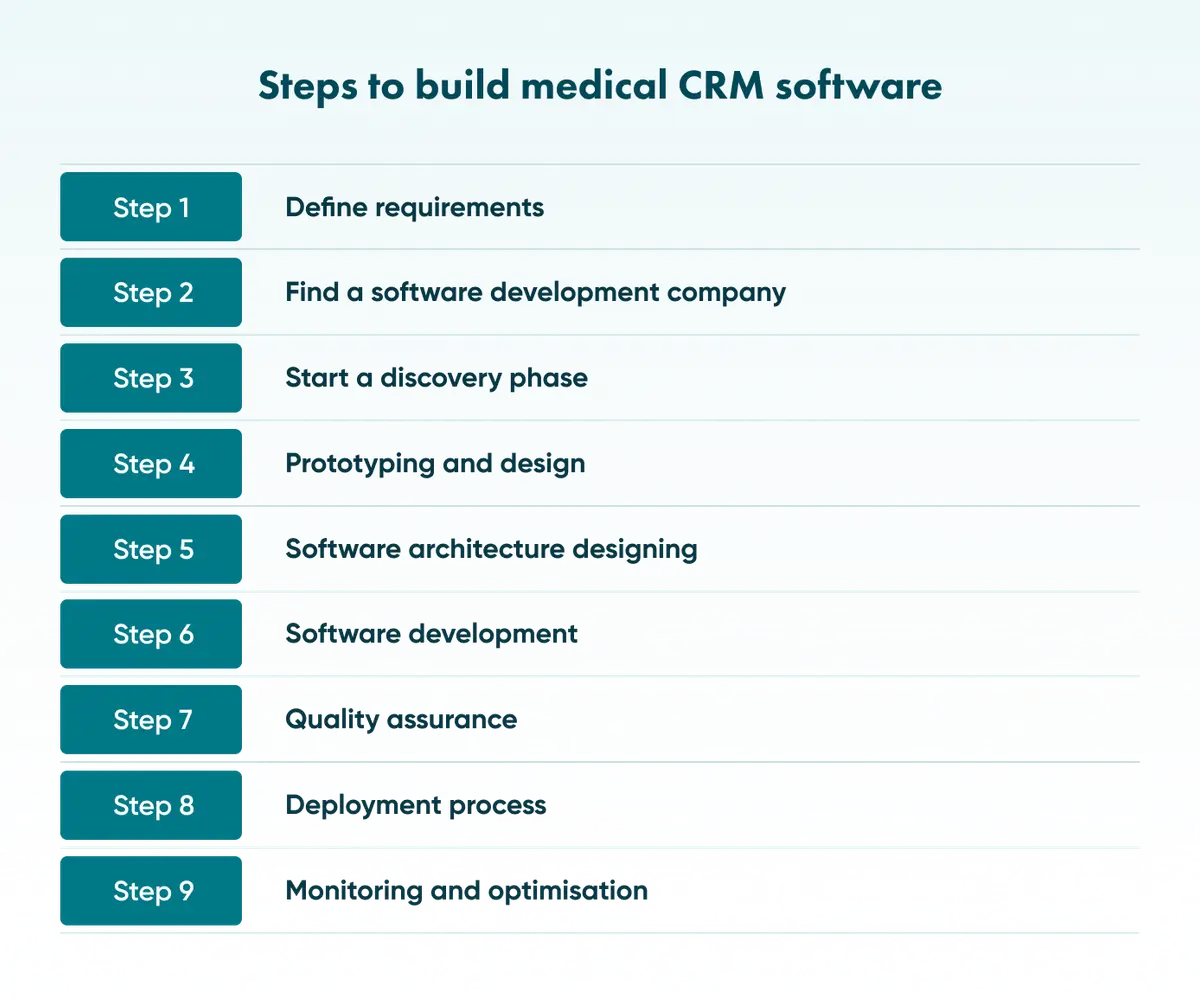
Learning how to build a CRM system from scratch is one thing. Doing it for a clinical environment, with all the compliance weight that comes with it, is another. Even so, the path for how to build a CRM system in healthcare follows a fairly consistent shape across most organisations.
1. Define requirements
Start by identifying the needs of providers, patients, and other stakeholders, then write out the feature list the system actually needs. Skipping this step is the single most common reason CRM projects run over budget.
2. Find a development partner
Look beyond your immediate region. Directories like Clutch and GoodFirms help shortlist teams offering healthcare CRM software development, and nearshore or offshore partners often deliver the same quality at a lower cost. Some organisations bring in healthcare CRM consulting first, just to pressure-test their requirements before signing a development contract. Go Wombat's own custom CRM software development services cover healthcare CRM software development services from discovery through to launch.
3. Start a discovery phase
Before any code gets written, a proper discovery phase brings the development team, stakeholders, and clinical staff together to define scope, surface risks, and agree on requirements. It's tempting to skip this and start building. Don't. This is where most of the expensive mistakes get caught early, instead of in production.
4. Prototyping and design
Early prototypes let real users react to the interface before it's fully built. Feedback at this stage is cheap. Feedback after launch is not.
5. Software architecture design
This is where modules, data models, and integrations with EHRs or telehealth platforms get mapped out, with scalability, security, and performance built into the plan rather than bolted on afterwards.
6. Development
Backend and frontend teams build the modules, design the interface, and wire up integrations, usually in agile sprints, so testing happens alongside development rather than only at the end.
Sweden's Alfa eCare offers a useful real-world reference point here. Go Wombat built its Epsilon system, a platform that lets home care and community health staff document, record, and digitally sign medication plans across municipalities and private providers in Sweden. The build had to handle authorisation layers, mobile access for field staff, and integration with existing care workflows. Those are the same categories that show up in most healthcare CRM builds.
7. Quality assurance
Functional, performance, and security testing catch bugs before real patients and staff do. Our software testing services cover this stage end-to-end, and healthcare providers are welcome to run their own acceptance testing on top of it.
8. Deployment
Installing the software, configuring settings, and training end users properly, with training tailored to each role rather than a single generic walkthrough.
9. Monitoring and optimisation
Launch isn't the finish line. Tracking uptime, adoption, and patient satisfaction after go-live is what keeps a CRM useful two years on rather than abandoned after six months. IT support and maintenance covers this ongoing work.
Every one of these nine steps looks straightforward on paper. In practice, steps three and five are where most healthcare CRM projects either find their footing or start drifting off budget. See how we'd approach yours.
Challenges to plan for when building a healthcare CRM
So what actually derails a healthcare CRM project? Usually, it's one of five things.
Scalability
As a provider's patient base grows, so does everything else: more data, more users, more load. The system either handles that gracefully or it doesn't.
Security
Sensitive patient data makes a CRM a target. That's not a hypothetical. Cybersecurity consulting built into the architecture, not added afterwards, is what actually holds up under a real attack attempt.
Integration with existing systems
EHRs, telehealth platforms, and legacy software often use different data formats. On paper, connecting them looks like plumbing. In practice, it's usually the part of the build that takes the longest.
User adoption
Here's an uncomfortable truth: a CRM that clinical and administrative staff find confusing simply won't get used, no matter how capable it is on paper. All that engineering effort, sitting unused.
Interoperability and regulatory pace
Rules move fast. Health systems that treat AI adoption as a side project are already behind. Nashville-based Ardent Health rolled out an ambient AI platform across its ambulatory network in 2026. A pilot across 17 specialities had already cut documentation time by 45% and saved clinicians roughly five hours a week. Any healthcare CRM development plan that treats this pace of change as an afterthought will need a rebuild sooner than expected.
Key Takeaways
Learning how to build a CRM system from scratch is not a weekend project, and off-the-shelf builders can't deliver the depth a clinical environment needs. Getting the requirements, architecture, and compliance right the first time costs less than fixing them after launch. Talk to our engineers about scoping a healthcare CRM built around your organisation's actual workflow.
Frequently Asked Questions
What is CRM healthcare software, and what does CRM stand for in healthcare?
CRM stands for customer relationship management. In a healthcare setting, that means a tool providers use to manage interactions with patients alongside the administrative and operational side of a practice. Think patient data, scheduling, and automated tasks tied to patient care.
How is CRM used in healthcare?
Providers use it to manage patient demographics, medical history references, and test result notifications, schedule appointments and send reminders, manage waitlists, and communicate with patients over email, SMS, or other channels.
What CRMs do hospitals use in 2026?
Among the top healthcare CRM options, Salesforce Health Cloud (now expanding into Agentforce for Health) remains the most common purpose-built choice. Microsoft Dynamics 365 and HubSpot are frequently customised for CRM software for use in the healthcare industry. Larger healthcare CRM companies and health systems alike are moving toward custom builds instead, mainly to get AI-assisted engagement without vendor lock-in. Whichever route a provider takes, the best healthcare CRM software for their situation is the one built around their actual referral and compliance workflow, not the one with the longest feature list.
What's the difference between a CRM and an EHR?
An EHR documents clinical care within one organisation; a CRM manages relationships and engagement, often across several organisations, including referring physicians and insurers. See the comparison table earlier in this guide for a full side-by-side breakdown.
How much does it cost to build a healthcare CRM system?
Cost depends on feature scope, integrations, and compliance requirements, and a proper estimate only comes out of a discovery phase. As a rough anchor, a mid-complexity custom build with EHR integration and mobile access typically runs into six figures once discovery, development, QA, and deployment are all counted.
Is a custom healthcare CRM HIPAA and GDPR compliant by default?
No system is compliant "by default." Compliance has to be designed in from the architecture stage, covering encryption, access controls, and audit trails, then verified through testing before launch.
Share and subscribe to our blog
Related articles

A Comprehensive Guide to EHR System Development
Companies in all industries go online to provide customers with high level services. Today, it’s difficult to become an industry leader if you don’t have an online presence and/or web or mobile app. This is especially true in critical sect…

Hiring A Full-Stack Development Company
The benefits, challenges, and steps Nowadays, business owners want to work with a company that provides a wide range of development capabilities and a team capable of creating complex software from scratch. The search for a full stack comp…

Project Discovery Phase in Software Development
What are the important elements of a discovery phase and how important is it for a project? According to Statista, 48% of software projects fail due to poorly documented requirements and tasks. Therefore, it is essential to elaborate on al…

Why Use a CRM System? 7 Reasons Businesses Can't Afford to Skip One in 2026
Why you cannot afford not to use CRM For many years, a good customer relationship management system was a pen and a piece of paper tucked in a salesman’s pocket, only to be replaced by digital records in an excel file. Eventually, a dedica…

How can we help you ?