



What Is the Software Development Life Cycle (SDLC) in 2026?

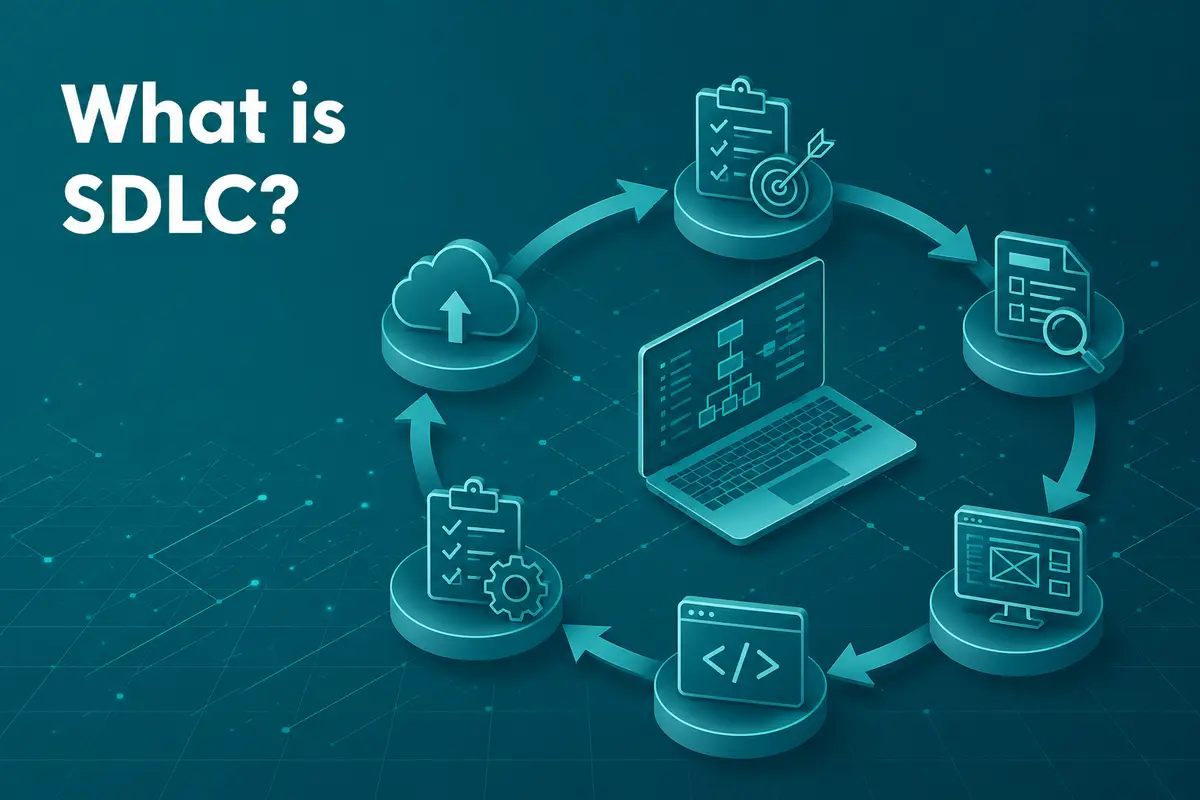
A missed requirement rarely stays small. By the time it surfaces in testing, or worse, once the software is already live, fixing it can cost far more than catching it on day one.
This is roughly what the software development life cycle, or SDLC, exists to prevent. It gives engineering teams a repeatable structure for building software, from the first conversation about scope to the last patch after launch. Micro, small, and medium-sized enterprises make up around 90% of businesses worldwide and 60 to 70% of global employment, according to the United Nations, which means getting this process right matters to far more companies than just the enterprise giants.
Two forces are reshaping how that structure works in 2026. AI-assisted coding is changing how fast teams move through each phase. Tighter security regulations are changing what "finished" actually means before software ships. This guide walks through both, alongside the models, phases, and roles that make up a working SDLC.
What is the SDLC and how does it work?
-blogDetail-1200x704.webp)
Strip away the jargon, and the SDLC is just a structured way of planning, building, testing, releasing, and maintaining software. It sets clear entry and exit criteria for every stage. That way, a team always knows what "done" looks like before moving on.
A rough way to picture the goal: high quality, delivered for a lower cost, in the shortest workable time. Nobody hits all three perfectly. That tension between speed, cost, and quality is the entire reason a defined process exists, rather than everyone just working it out as they go.
The current governing standard is ISO/IEC/IEEE 12207:2017, which covers software life cycle processes across acquisition, supply, development, operation, and maintenance. It applies across industries as different as aerospace, finance, and healthcare.
Roles and responsibilities in the SDLC
An SDLC only works if the right people make the right decisions. Here is who typically sits around the table.
Project manager
Plans, executes, delegates: that is the project manager's job in three words. Day to day, they hold the deadlines and the budget, and they are usually the first to notice when either one starts slipping.
Project sponsor
Someone senior needs to back the project, and that is the sponsor's role. They sit in senior management, provide resources and support, and keep communication open between the project manager and other decision-makers.
Developers
Writing, testing, debugging, maintaining. Developers do all four, using the languages and frameworks suited to the project. Their day-to-day work looks different depending on whether they specialise in frontend, backend, or full-stack roles, something worth understanding before hiring a full-stack development company for a project that spans both.
Designers
Designers rarely work in isolation. They sit alongside developers and product managers, shaping interface design and new features so requirements turn into something a user can actually navigate.
Business analyst
Somewhere between the technical team and the business side sits the business analyst. Their job is keeping the two aligned: documenting the business process, analysing requirements, and acting as a translator when the two sides talk past each other.
Release manager
Worrying about what could go wrong before it does, that is the release manager's whole remit. They plan the release schedule and manage risk from the earliest stages of development through to the final rollout.
-blogDetail-1200x369.webp)
What are the 6 main SDLC models?
Every SDLC needs a model: a way of sequencing the phases. Here are the 6 that come up most often.
Waterfall model
Waterfall is the oldest of the six, first described by Dr Winston W. Royce in 1970. It moves through phases in strict order, each one finishing before the next begins, with no going back. Fixed, well-understood requirements suit it well. Anything that needs to change mid-flight does not.
Iterative model
Think of Iterative as Waterfall's mirror image. Teams ship a working version at the end of each cycle, then repeat. Slower on paper. In production, it usually catches bugs earlier and makes changes cheaper, since nobody waits until the very end to discover something is broken.
Agile model
Agile breaks a project into builds, then breaks each build into short iterations, typically one to three weeks long. Testing happens after every iteration, and the client stays close throughout. That closeness has a cost: priorities can shift mid-project, adding work and pushing back the release.
Lean model
Cut anything that does not add value for the client, whether that is time, money, or extra functionality: that is Lean in one line. Eliminate waste. Decide as late as possible. Deliver as fast as possible. No multitasking, either. Everyone works on the task in front of them.
V-shaped model
V-shaped pairs every development stage with a matching verification step, creating a disciplined process that leans hard on testing throughout. It suits projects where the requirements are clear and unlikely to shift.
Spiral model
Spiral loops through four phases again and again until the project is done, refining the product each time based on user feedback. Flexible, yes. Also hard to finish if the team cannot resist adding one more improvement every round. Best reserved for large, complex projects.
What are the 7 phases of the SDLC?
-blogDetail-1200x808.webp)
Regardless of which model a team chooses, most SDLCs move through the same 7 phases.
1. Planning or discovery
Every project needs a plan before the first line of code gets written, in the same way nobody builds a house from a mental picture alone. This phase, sometimes formally run as a discovery phase, sets goals, tools, cost estimates, and requirements. Skipping it is one of the more expensive mistakes a team can make, something we cover in more detail in our piece on the project discovery phase in software development.
2. Requirements and analysis
Here, the team gathers as much detail as possible about what the client actually needs, then documents it for later stages. Specialists set up structured communication with the client, analyse whether the proposed system can realistically meet expectations, and write it all down so nothing gets lost between meetings.
3. Design and prototyping
Developers choose the architecture, programming languages, and frameworks that fit the project. At Go Wombat, that often means Python, JavaScript, React, React Native, or Django, depending on what the product needs to do. This phase usually includes UI/UX design work and, where useful, a prototype so stakeholders can react to something concrete rather than a document. A design document then guides the rest of the team through what comes next.
4. Software development
This is where the design becomes working code. Developers build the framework in the chosen language, using compilers, debuggers, and interpreters as needed. Coordinating a team of programmers through this stage is its own discipline, one reason custom software development projects benefit from a clear process, not just skilled individuals.
5. Testing
Testing usually starts once the product reaches a dedicated environment, separate from where it was built. The goal is straightforward to state and harder to execute well: find the bugs, communicate them clearly to developers, and confirm the software meets what was agreed in the first phase. Our guide to the 7 principles of software testing and our piece on quality assurance in software engineering both go deeper into how this stage should work in practice.
6. Deployment
Deployment is when the software reaches its actual users, sometimes alongside training documentation to help them get the most out of it. Most deployment today is automated, but that does not remove every risk. Real-world use surfaces issues that no test environment quite predicts, and early user feedback often reshapes the next release.
7. Maintenance
This is the users' stage. Developers keep updating the software to match changing needs, fix bugs that only show up under real load, and close vulnerabilities as they are discovered. Ongoing IT support and maintenance are what keep this phase from becoming an afterthought.
Secure SDLC: why security can't be bolted on in 2026
Most teams still treat security as a testing-phase checklist. Tick a box near the end, ship it. That habit is becoming a legal liability, not just a technical one.
The EU Cyber Resilience Act makes security-by-design a requirement, rather than a suggestion, for digital products sold in the EU. Vulnerability and incident reporting obligations begin in September 2026, with full compliance required by December 2027, and the underlying principle, building cybersecurity in from the start rather than adding it afterwards, is exactly what a secure SDLC is meant to deliver. NIST's Secure Software Development Framework, currently being updated to version 1.2, gives teams a concrete set of tasks for embedding security into each phase rather than treating it as a separate workstream.
The cost of skipping this is not hypothetical. In 2024, a backdoor was discovered inside XZ Utils, a compression library used across most Linux distributions, after an attacker spent over two years building trust as a maintainer before quietly inserting malicious code, tracked as CVE-2024-3094 with the maximum possible severity score. It was only caught because an engineer happened to notice a small performance regression during unrelated testing. Shift-left security, the practice of testing and reviewing for vulnerabilities from the earliest phases rather than the last one, exists precisely to reduce reliance on that kind of luck.
Practically, this means threat modelling during design, automated dependency scanning during development, and a software bill of materials maintained throughout the project, not assembled after the fact. Our cybersecurity consulting and GDPR consulting work both fold into this, and we cover the broader stakes in the importance of cybersecurity for SMEs.
How AI is reshaping the SDLC in 2026
AI has moved from novelty to habit inside most engineering teams, and fast. According to Stack Overflow's 2025 Developer Survey, 84% of developers now use or plan to use AI tools in their workflow. 51% use them daily. That is up from 76% overall usage the year before.
That shift touches nearly every SDLC phase. Requirements documents get drafted faster with AI assistance. Boilerplate code gets generated instead of being typed out by hand. Test cases get suggested automatically rather than being written from scratch. None of this replaces the phases themselves. The same survey found developer trust in AI output actually dropped compared with the previous two years, even as daily use kept climbing. Teams are relying on these tools more while trusting them less, which is an odd but telling combination.
The practical takeaway is not to skip review because a tool wrote the first draft. It is to treat AI output the way you would treat a fast but occasionally careless junior developer: useful, quick, and still in need of a second pair of eyes before anything ships. Our AI services and solutions team builds this kind of oversight into client workflows rather than bolting it on afterwards.
SDLC benefits for SMEs
-blogDetail-1200x554.webp)
A clear SDLC pays off in three main ways.
A streamlined process
When everyone knows exactly what stage a project is in, communication gets easier, and productivity climbs without needing extra headcount or budget.
Early problem identification
Bugs are expensive latecomers. A working SDLC catches them earlier, when they are still cheap to fix, instead of letting testing happen too late (or too early to catch anything meaningful) and letting problems slip through to release.
Easier problem-solving
Discipline is what you get from sticking to one model instead of improvising as you go. It keeps communication open across the team, so problems get spotted and solved faster. This holds whether the SME in question is building a booking platform for a manufacturing client or a fintech product for consumers.
Most delays trace back to one skipped phase. Talk to our engineers about where your current process is losing time.
Key takeaways
The SDLC has not changed much in shape since Royce first described the waterfall model in 1970. What has changed is what "good" looks like inside it. Security now has to be designed in from the planning phase, not inspected for at the end. AI now touches almost every phase, from requirements to testing, without removing the need for a human to check the output.
Pick a model that suits your team and your project, follow the 7 phases with discipline, and treat both security and AI as part of the process rather than an add-on to it. That is what separates software that ships on time from software that quietly becomes someone's full-time job to fix.
Ready to tighten up your own development process? Share your project brief, and we will walk through where the SDLC can work harder for you.
Frequently asked questions
What is the SDLC in simple terms?
Think of the SDLC as a structured process for planning, building, testing, releasing, and maintaining software. It breaks a project into defined stages, so teams always know what comes next and what "done" means at each point.
What are the 7 phases of the SDLC?
Planning, requirements and analysis, design and prototyping, development, testing, deployment, and maintenance. Different models sequence or repeat these phases differently, but most SDLCs touch all 7 in some form.
What is the difference between SDLC and Agile?
The SDLC is the overall process a project follows. Agile is one model for running that process, built around short iterations and frequent client feedback, rather than a single long, linear sequence like Waterfall.
What is a secure SDLC?
A secure SDLC builds security tasks, such as threat modelling, dependency scanning, and code review, into every phase, rather than testing for vulnerabilities only at the end. Frameworks like NIST's SSDF and regulations like the EU Cyber Resilience Act are pushing this from best practice toward a requirement.
Which SDLC model works best for a small team?
Agile or Iterative models tend to suit smaller teams best, since both allow course correction without committing months of work to a single, unchangeable plan. Waterfall works better when requirements are genuinely fixed and unlikely to shift.
How is AI changing the software development life cycle?
AI tools now assist with requirements drafting, code generation, and test case creation across most of the SDLC. Adoption is high, but so is scepticism about output quality, so most teams still treat AI as a fast first draft rather than a final answer.
Share and subscribe to our blog
Related articles

Understanding CI/CD in Software Development
H ow CI/CD can be incorporated into a project to enhance its efficiency and accuracy It's not a secret that constant and wise improvements lead to success. We are used to updating our hardware and software and looking for a way to be more…

GitOps Vs. DevOps - What are the key Differences and Challenges?
Software development teams are constantly looking for ways to improve their development processes. They strive to apply modern methodologies which help them speed up and optimise the development of clients’ software. DevOps is one methodol…

Project Discovery Phase in Software Development
What are the important elements of a discovery phase and how important is it for a project? According to Statista, 48% of software projects fail due to poorly documented requirements and tasks. Therefore, it is essential to elaborate on al…

Kubernetes vs Docker
If you’re a little confused about containerisation and have doubts about deployment, this article can help. We’ll talk about those general concepts and take a look at two popular, related technologies driving the container revolution: Dock…

How can we help you ?