



AI CRM Software Development: The 2026 Complete Guide

AI CRM software development refers to the process of developing or improving customer relationship management systems with the inclusion of artificial intelligence and machine learning features. This leads to a situation where a customer relationship management system does not merely store customer information, but also analyses the information, automates tasks, and makes predictions, which a normal customer relationship management system cannot achieve.
To businesses with complex sales cycles, large customer bases, or high churn sensitivities, the difference between a normal customer relationship management system and an artificial intelligence customer relationship management system is no longer incremental; it's structural.
Traditional CRM vs AI-Powered CRM: What Actually Changes
A traditional CRM is simply a record-keeping and workflow system. It stores contacts and interactions, records pipeline stages, and reminds you of things. It does what you set it to do and nothing else.
An AI-powered CRM is different. It uses what it learns from what it collects to reveal insights, point out potential pitfalls, and make decisions on its own. This is an important point because these two systems require different things from those who use them and those who build them.
In a traditional CRM system, entering data is either manual or rule-based. Prioritising leads is done by following predetermined rules. Segregating customers is done manually. Forecasting is done by using averages. Handling customer service involves using a ticket system. Personalisation is done by using templates. Detecting customer churn is done by using lagging indicators.
An AI-powered CRM changes each of these. Data entry becomes automated and self-updating. Lead scoring becomes dynamic, adjusting in real time as new behavioural signals arrive. Segmentation is driven by ML clustering rather than manual grouping. Forecasting draws on predictive modelling rather than pipeline averages. Customer service is handled in part by conversational AI capable of resolving common issues without human involvement. Personalisation operates at the individual level, in real time. And churn detection shifts from a lagging indicator to an early warning system.
The transition from one to the other is not a feature toggle. It requires a clean data infrastructure, the right ML models, and an integration architecture that most legacy CRM setups do not have out of the box. That is where custom development becomes relevant.
Core Benefits of AI and Machine Learning in CRM
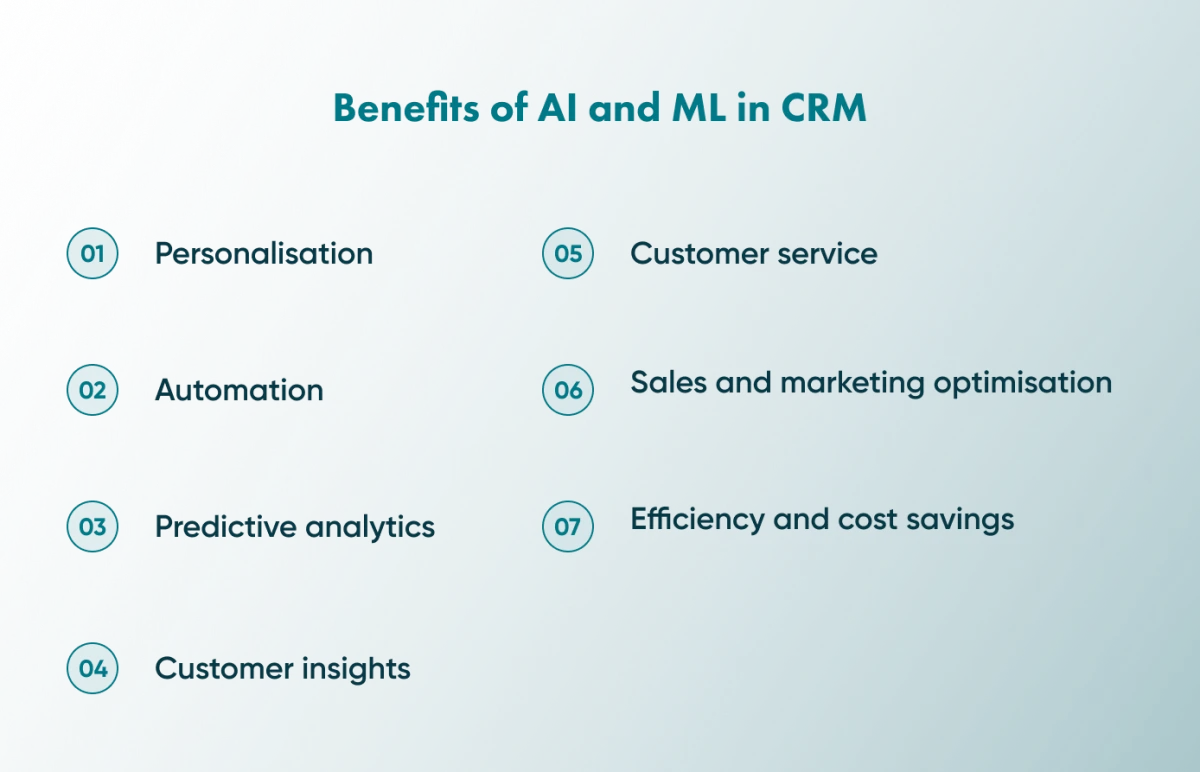
Personalisation at Scale
AI uses purchase history, browsing patterns, support interactions, and engagement patterns to develop a dynamic understanding of each customer, which in turn drives highly personalised content, offers, and timing across all channels, automatically and in real-time.
The operational impact is substantial, as marketing teams no longer send the same communication to everyone, but rather deliver contextually relevant communication to the right person at the right time, which boosts conversion rates. Unsubscribe rates fall.
Intelligent Automation
Even routine CRM tasks, such as data entry, lead assignment, follow-up scheduling, and contact enrichment, tend to occupy a large amount of sales teams' time. These tasks are also managed by AI, which does not discriminate between sales reps or shifts.
The result is not just time saved. It is error reduction, faster pipeline movement, and sales teams who spend their hours on conversations rather than administration. Business process automation built into a CRM at the architecture level delivers far more than bolt-on automation tools applied after the fact.
Predictive Analytics and Churn Prevention
ML models trained on historical customer data recognise the behavioural patterns that lead to conversion, disengagement, and churn. Once the patterns are recognised, the system continually analyses live data and alerts for risks before they become actual loss.
Detecting early churn is one of the most important features an AI CRM can offer to a subscription business or an enterprise account with a long sales cycle. Responding to a signal three weeks before a customer cancels is a fundamentally different response from reacting to a cancellation notice.
Machine learning services applied to CRM forecasting can also generate revenue predictions significantly more accurate than pipeline-based averages, giving leadership teams a cleaner picture for planning.
Deeper Customer Insights
Customer information aggregated at this level can show patterns that would not be apparent from the information held by a single analyst: for example, what kinds of products are associated with long-term retention, what kinds of interactions are associated with upgrade behaviour, and what kinds of acquisition strategies generate the highest customer lifetime value.
Sales and Marketing Optimisation
The AI figures out which leads are more likely to convert, suggests what action is next best for each lead, and highlights content that matches each lead's stage of the buying process. The sales team gets more clarity. The marketing team gets more insight into their campaigns. The overall cumulative effect of all these improvements is enormous. The marginal improvement in lead quality, conversion rates, and deal velocity compounds very fast.
Key AI and ML Applications in CRM Systems
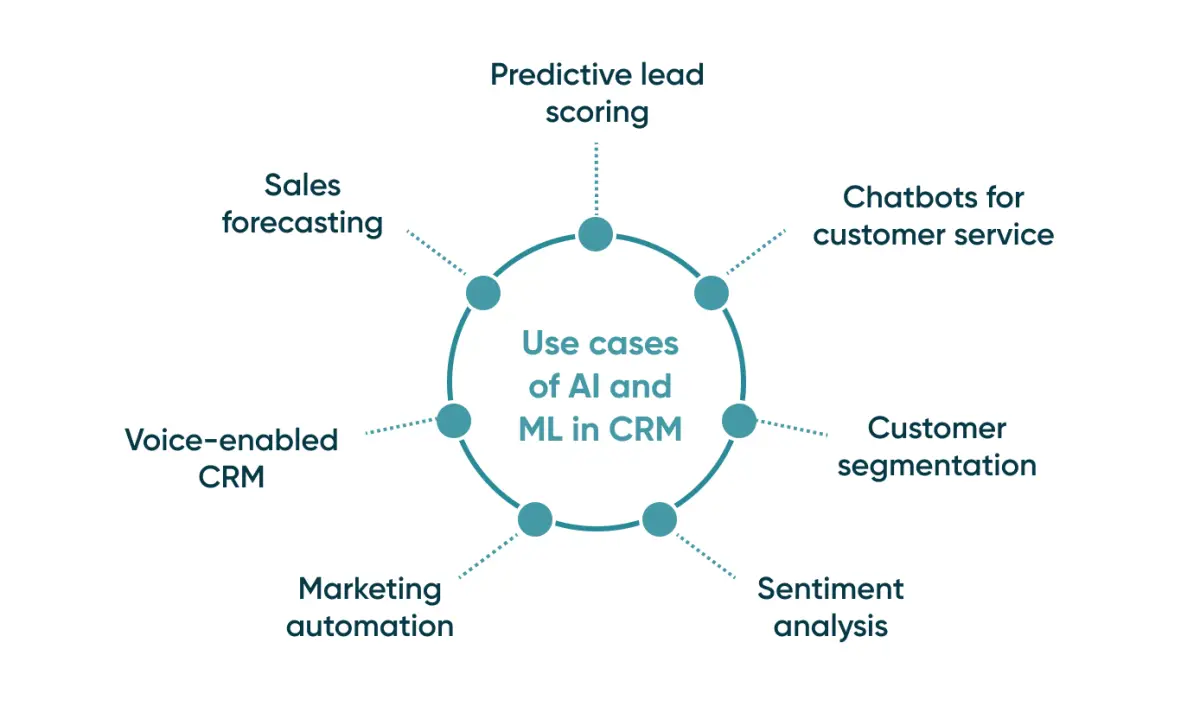
Predictive Lead Scoring
Predictive lead scoring uses historical conversion data to train a model to learn and replace rule-based lead scoring. It uses demographics, behaviour, historical engagement, and firmographics to calculate a score for each lead based on their conversion probability.
The sales team no longer wastes time on leads with a low probability of conversion. They instead focus on leads where they are most likely to see results. The model gets better and better with each conversion result.
AI Chatbots and Conversational Support
Routine customer inquiries are handled by AI-driven chatbots 24/7 for things like the status of an order, information about a product, basic troubleshooting, and scheduling an appointment without the need for human intervention. More complex issues are routed to the right person with the context already captured.
Yes, the improvement in the customer experience is real: instant response at any time of day, consistent quality regardless of the volume, and human representatives available for conversations where judgment is needed. ChatGPT integration services can extend this capability significantly, enabling conversational experiences that go well beyond scripted responses. For a deeper look at where this is heading, our article on the future of chatbots for marketing covers the trajectory in detail.
Customer Segmentation
ML algorithms analyse behavioural, transactional, and demographic data simultaneously to identify customer clusters with shared characteristics. These clusters are not static categories assigned manually. They shift as customer behaviour evolves, keeping segmentation accurate without ongoing manual effort.
The marketing implication is straightforward: more relevant messaging, better campaign targeting, and higher engagement rates across every segment.
Sentiment Analysis
Natural language processing can be done on customer interactions such as emails, tickets, reviews, and even mentions on social media sites. Sentiment trends are detected by this method. Peaks in negative sentiments generate alarms.
Sentiment analysis is a method for businesses with a large customer base and those that operate through various channels to constantly monitor their customers' sentiments. This cannot be done through survey-based methods.
Marketing Automation
AI-driven marketing automation goes beyond scheduling emails and posting to social channels. It personalises content at the individual level, adapts campaign logic based on engagement signals, and identifies the optimal timing and channel for each communication.
Top marketing automation trends show that the gap between businesses using AI-driven automation and those running static drip sequences is widening quickly, particularly in competitive acquisition environments.
Sales Forecasting
AI-based forecasting models analyse historical sales data, deal progression patterns, market signals, and rep behaviour to generate revenue predictions that account for far more variables than pipeline-stage averages. The result is forecasts that sales leadership can actually rely on for planning, hiring, and investment decisions.
Voice-Enabled CRM
Voice interfaces allow sales teams to update records, retrieve customer information, log call outcomes, and create tasks without touching a keyboard. For field sales teams or anyone moving between calls, this removes one of the most persistent friction points in CRM adoption.
The leading platforms are building this capability natively. For custom CRM builds, voice integration is increasingly a standard requirement rather than a premium feature.
Agentic AI in CRM: The 2026 Shift
The most significant development in AI CRM in 2025 and 2026 is not a new feature. It is a new operating model.
Agentic AI refers to AI systems that do not just respond to inputs but pursue goals autonomously across multi-step workflows. In a CRM context, this means an AI agent that can identify an at-risk customer, draft a personalised retention offer, schedule an outreach sequence, update the account record, and notify the relevant account manager, without a human initiating any individual step.
Salesforce Agentforce and HubSpot Breeze represent the early commercial implementations of this model. But the category is moving fast, and the off-the-shelf versions carry significant constraints around customisation, data control, and integration with non-standard tech stacks.
For businesses with complex workflows, proprietary data structures, or specific compliance requirements, custom agentic AI development delivers capabilities that packaged platforms cannot. The architecture looks different from standard ML integration: it involves agent orchestration layers, tool-use frameworks, memory systems, and feedback loops that require deliberate design rather than configuration.
Go Wombat's AI services and solutions work now includes agentic CRM development for clients who need this capability built to their specific operational requirements, not adapted from a vendor template.
This is the direction the entire CRM category is moving. Businesses that build the foundational data infrastructure and integration architecture now will be significantly better positioned to adopt and extend agentic capabilities as they mature.
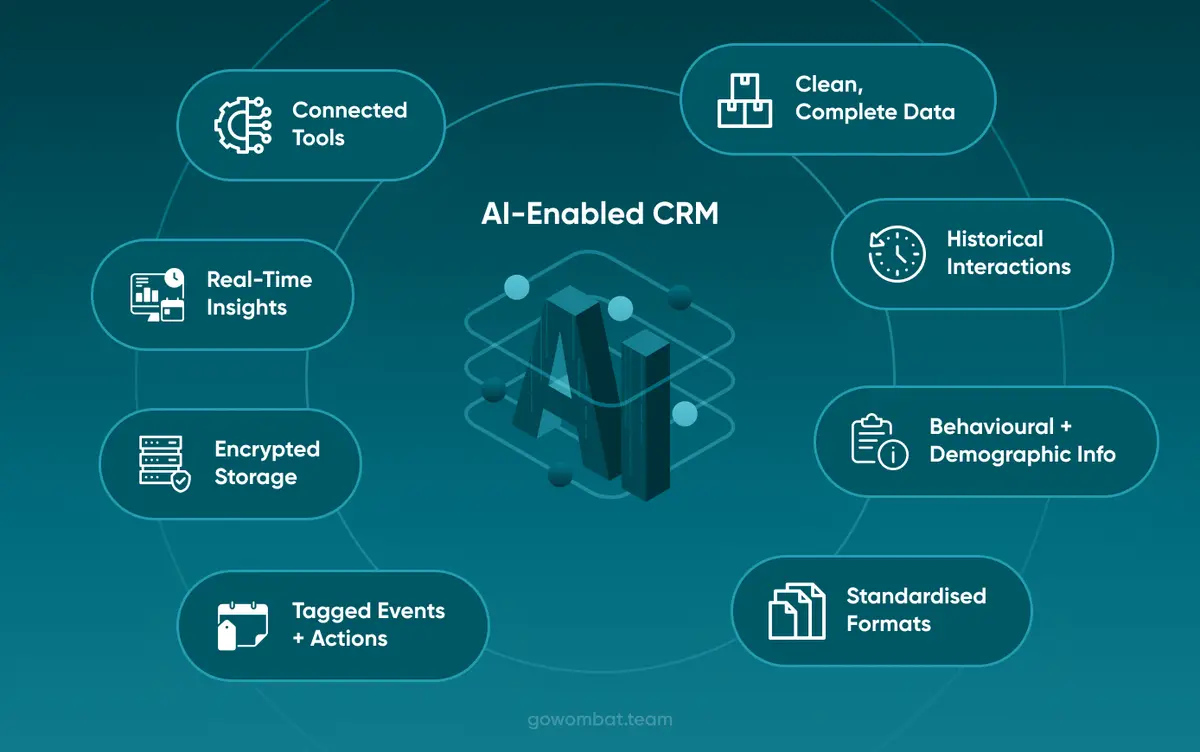
Is Your CRM Ready for AI? A Data Readiness Checklist
Adding AI to a CRM that is not data-ready produces unreliable outputs and erodes trust in the system quickly. Before any AI or ML development begins, the following conditions need to be in place.
1. Data Quality
Historical records and customer data must be accurate, complete, and free of duplicates. AI trained on poor data learns the wrong patterns. Automated data entry tools can help maintain quality on an ongoing basis, but a data audit before any AI project begins is non-negotiable.
2. Data Volume
ML models need a large history of data to recognise significant patterns. Sales leads, purchases, support requests, emails, and customer interactions are examples of this. The more history, the better the results will be for the ML model.
3. Data Diversity
Restricting data inputs to sales transactions produces narrow models. Behavioural data, demographic data, support interaction history, and product usage data give AI systems a fuller picture and more angles from which to generate accurate predictions.
4. Data Consistency
However, the formatting has to be consistent across all data sets, including date, identifier, and name formatting, to ensure the reliability of the output generated by the AI tool. Without this consistency, the results generated by the AI tool will be inconsistent, irrespective of the quality of the tool.
5. Integrations and APIs
An AI CRM that does not have the capability to integrate with the rest of the technology stack, including ERP systems, marketing systems, analytics systems, and data warehouses, is essentially living in isolation. The more integrated the CRM, the more data the AI tool has to work with, and the more useful the output generated by the tool will be.
6. Real-Time Data Capability
A model based on a static snapshot of data misses the very signals that matter most: behavioral changes in real time, current engagement patterns, and ongoing customer interactions. Real-time data feeds are what distinguish between a system that tells you before a customer actually churns and one that simply confirms after they do.
7. Data Security and Compliance
AI training processes involve sensitive customer data. Strong access controls, data encryption, and GDPR compliance are not optional additions. They need to be designed into the architecture from the start, not retrofitted once the system is live.
8. Clear Event Tracking and Labels
AI models learn from labelled signals. Events like "demo booked," "proposal sent," and "purchase completed" need to be tracked consistently and tagged clearly. Better-labelled data produces faster model learning and more actionable outputs.
How to Implement AI in CRM Software: 7 Steps
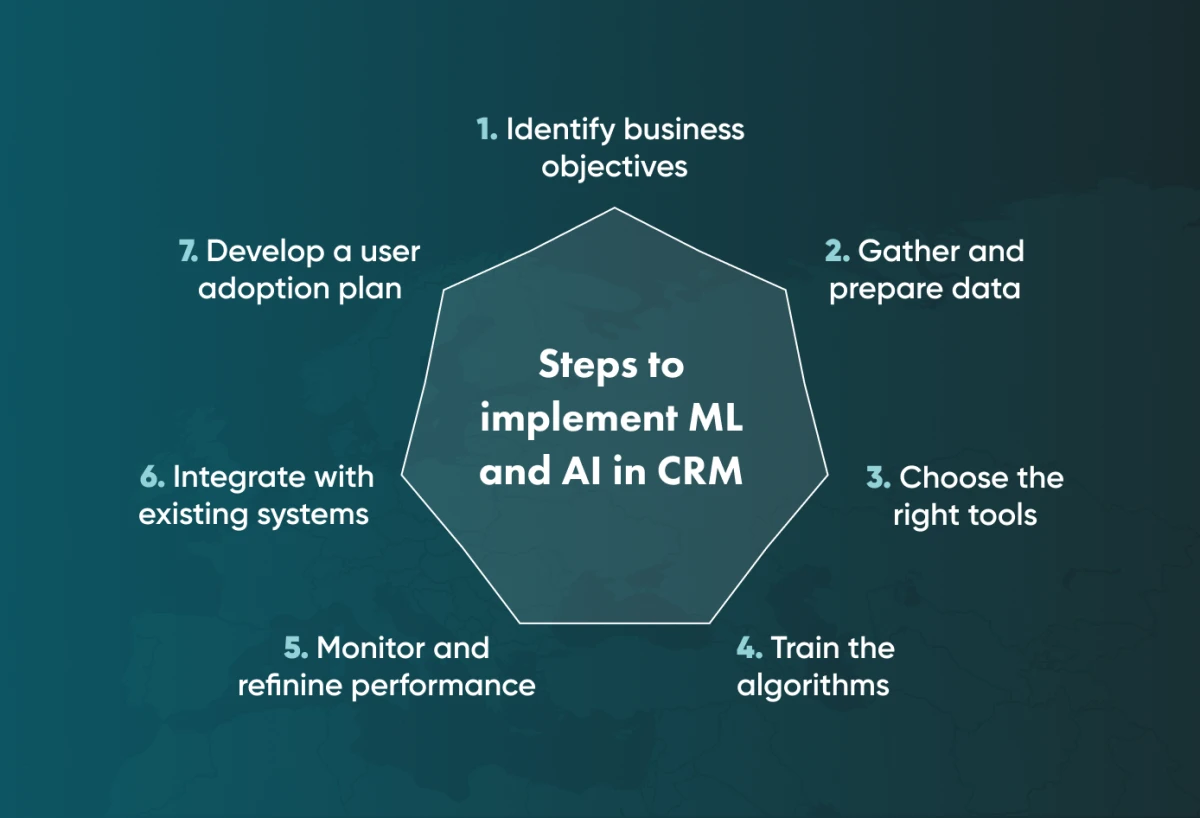
1. Define Business Objectives First
AI projects initiated based on technology, rather than business issues, are unlikely to produce value. The common denominator for all AI projects is always the business outcomes required, and how the business's CRM is currently failing to deliver those outcomes. Churn reduction, lead quality improvement, and cost reduction are very different business issues, requiring different AI approaches.
2. Audit and Prepare the Data
Clean, well-structured, and correctly labelled data is the foundation upon which everything else is built. This step involves identifying data gaps, resolving any data inconsistency issues, integrating data that is currently in silos, and defining the data pipelines that will be used to maintain the system after launch.
3. Select the Right Tools and Architecture
The choice between extending an existing CRM system with AI capabilities, integrating third-party ML tools, or developing custom models depends on the complexity of the use case, the uniqueness of the business data, and the level of control. There is no clear winner, and the right choice depends on an honest assessment of the trade-offs involved with each option.
4. Train and Validate the Models
ML models are also trained on existing data, and the accuracy of these models is tested against other held-out data sets. The training of ML models is a continuous process, where the models are initially tested, refined, and then retested until the performance of the model reaches the expected level. Hurried training results in models that are good on paper but fail in real-life scenarios.
5. Integrate with Existing Systems
A model of AI running in isolation from the rest of the technology stack does not deliver much value. Integrating with ERP systems, marketing tools, support tools, and data infrastructure ensures that the results of an AI model are available where decisions are actually being made and not locked away in an analytics sandbox.
6. Monitor Performance and Refine Continuously
These models also tend to degrade over time as customer behaviour, the market environment, and the business processes change. This requires constant monitoring to detect when the performance of the model is starting to degrade and scheduled training cycles to maintain the accuracy of the output.
7. Build a User Adoption Plan
Even the best AI CRM system will be useless if the people on the team do not use it. The sales and support teams need to understand what the system does, trust the information the system is providing them, and understand how to take action on the information the system is providing them.
Build vs Buy: When Custom AI CRM Development Makes Sense
Salesforce, HubSpot, and Zoho are examples of off-the-shelf AI CRM solutions that have made significant investments in AI technologies. They are the best option for a lot of businesses. However, there are some situations in which packaged solutions cannot provide the same value as custom creation.
When a company has customised data structures or procedures that typical CRM platforms cannot support without major workarounds, custom development makes sense. Every workaround results in a decline in AI accuracy and data quality.
It also makes sense that data management methods that cloud-based SaaS systems cannot ensure are required for compliance, especially in regulated industries like financial services, healthcare, or law. Or when the company needs to govern the model architecture to guarantee that outputs fulfil a particular quality or explainability requirement, or when it needs AI features that are not included in the platforms that are already in use.
Another important consideration is integration depth. Custom architecture is the more reliable option when existing internal systems, such as proprietary data warehouses, custom ERP builds, or legacy infrastructure, require more connection depth than standard CRM connectors can consistently handle.
Lastly, when amortised over three to five years, the license costs for business SaaS systems can make a custom build more cost-effective at a large enough scale.
For most use cases, off-the-shelf platforms are less risky and quicker to implement. Although custom builds are more time-consuming and expensive initially, they provide greater control, a better fit, and frequently reduced total cost of ownership at scale. The appropriate decision is based on the particular requirements rather than a generic rule. CRM software development with Go Wombat starts with an honest assessment of which approach actually fits the business's situation.
Challenges of Implementing AI in CRM
Data quality at the starting line
Once an AI project starts, most organisations find their data is messier than anticipated. Pre-implementation audits often reveal duplicates, gaps, uneven formatting, and improperly labelled events. It takes time to address this and is frequently overlooked when planning a project.
Legacy system integration
AI integration was not considered in the architecture of older CRM installations or related systems, such as ERPs, billing platforms, and support tools. Any AI development project is made more complex and time-consuming by the custom integration effort needed to connect them reliably.
Security and compliance
AI systems that have been trained on consumer data are subject to actual compliance requirements, especially under GDPR and industry-specific laws. Before training starts, rather than during a post-launch compliance review, the architecture must address data residency, access controls, audit trails, and model transparency requirements.
The talent gap
Proficiency in machine learning engineering, CRM architecture, data engineering, and integration development is necessary for successful AI CRM development. Most significant AI CRM initiatives involve an external development partner because most internal IT teams are understaffed for this mix.
Cost and timeline expectations
AI CRM projects are often funded and scoped as software feature enhancements rather than the infrastructure projects they are. The actual cost is increased by data preparation, model training, integration work, and continuous improvement. Companies that approach these projects with reasonable expectations perform significantly better than those that don't.
Ethical considerations
AI systems that affect marketing exposure, customer service quality, and sales prioritisation have significant consequences for fairness. Biased results are produced by biased training data. Companies must have clear procedures for spotting and fixing bias in their AI models as well as open guidelines for the communication and decision-making processes of AI-driven systems.
What AI-Powered CRM Will Look Like by 2030
Though the precise timeline is unclear, the trend from here is obvious.
Hyper-personalisation will become a standard expectation rather than a marketing goal. AI will use behavioural signals, intent recognition, and emotional context from live communications to create offers, content, and interaction sequences that are specific to each customer in real time.
The predominant operational model for CRM workflows will be agentic AI. The focus of human oversight will change from task management to goal-setting, outcome review, and handling exceptions that agents are unable to handle on their own.
In customer-facing AI, sentiment and emotion recognition will become commonplace, allowing support systems to adjust answer content, escalation levels, and tone according to the customer's emotional state during an engagement.
By continuously monitoring lifetime value trends, upsell readiness, and churn risk, the predictive customer health score will provide account teams with real-time insight into where to concentrate attention throughout their whole book of business.
Particularly in regulated businesses, privacy-first AI architectures, such as federated learning techniques that train models without centralising sensitive data, will become the norm rather than the exception.
Companies that engage in integration architecture and develop solid data foundations now are not merely getting ready for the potential of AI today. They are preparing for a CRM environment that will be very different from what it is now in 2028 and 2030.
Conclusion
AI and machine learning are not CRM software add-ons. They represent an alternative approach to developing and managing customer relationship infrastructure. The companies with the most advanced models are not the ones that will benefit most from AI CRM in 2026. They are the ones with clear knowledge of the particular issues they are attempting to resolve, clean data, and well-integrated systems.
The business's unique needs, data maturity, and legal environment will determine whether that entails expanding an already-existing platform, including specialised ML features, or creating a new AI CRM from the ground up.
From preliminary data readiness evaluations to complete bespoke AI CRM development and continuous model improvement, Go Wombat works with companies at every stage of this process. If you are evaluating what AI integration would look like for your CRM, contact us to talk through the specifics.
Frequently Asked Questions
What is AI CRM software development?
AI CRM software development means building customer relationship management systems that use machine learning and artificial intelligence. It’s about adding things like sentiment analysis, chatbots, automated tasks, predictive lead scoring, and sales forecasting. Sometimes that means upgrading existing CRM platforms with these features, other times it’s about creating a brand-new system from scratch with AI baked in.
What are the main benefits of AI in CRM?
What does AI actually bring to CRM? A lot. AI lets you personalise outreach at scale, automate the boring stuff, predict sales and churn, pull deeper insights from customer behaviour, and just makes sales and marketing teams way more efficient. Instead of just tracking what happens, your CRM starts helping you make decisions.
What is agentic AI in CRM, and why does it matter?
AI systems that pursue multi-step objectives independently rather than reacting to specific cues are referred to as agentic AI. Without human intervention, an agentic system in a CRM setting can recognise a risk signal, create a reaction plan, carry out an outreach sequence, update data, and alert the appropriate team member at each stage. This signifies a change from using AI as a reporting tool to using it as an operational layer in the CRM.
When does custom AI CRM development make more sense than an off-the-shelf platform?
If your company has unique workflows, proprietary data structures, compliance needs, or wants a deeper integration than standard platforms offer, custom development is the way to go. It’s also worth considering if you need AI features that just don’t exist on the market.
What data does a CRM need before AI integration can work effectively?
To really make AI work in CRM, you need good data. That means up-to-date customer info, lots of historical records from sales and support, uniform formatting and tagging, a real-time data pipeline, and strong security. If your AI is running on messy or incomplete data, it’ll give unreliable results—and nobody trusts a CRM that keeps messing up.
What are the biggest challenges in implementing AI in CRM?
The toughest challenges? Data quality always crops up first during the pre-launch audit, followed by figuring out how to weave AI into your existing systems. Security and compliance need attention from day one. Then there’s finding talent who understands both CRM architecture and machine learning. And, of course, working out the budget and timeline. The whole process gets easier if you treat AI CRM as a fundamental shift in how you work, not just a shiny new feature.
Share and subscribe to our blog
Related articles

Why Is the Digital Twin of an Oil Refinery the Most Complex AI System You Will Ever Build?
Building a digital twin of an oil refinery isn't a platform-selection problem — it's a physics, data, and integration problem stacked seven layers deep. From thermodynamics and sensor fusion to safety-critical control system integration, each layer depends on the one beneath it, and most failed projects trace back to programme design, not technology choice. This piece breaks down what actually makes refinery digital twins so hard to get right, with real deployment data from Cosmo Oil and Dangote showing what a well-scoped project looks like in practice.
How RAG Helps AdTech Platforms Reduce Campaign Data Hallucinations
RAG helps AdTech platforms reduce AI hallucinations by grounding outputs in real campaign data, making reporting, attribution and recommendations more accurate and auditable.

Native vs Cross-Platform Mobile Development: How to Choose in 2026
Compare native, Flutter and React Native development to find the right approach for your mobile product based on performance, cost, speed and scalability.

How can we help you ?