



How Does Logistics App Development Work in 2026?

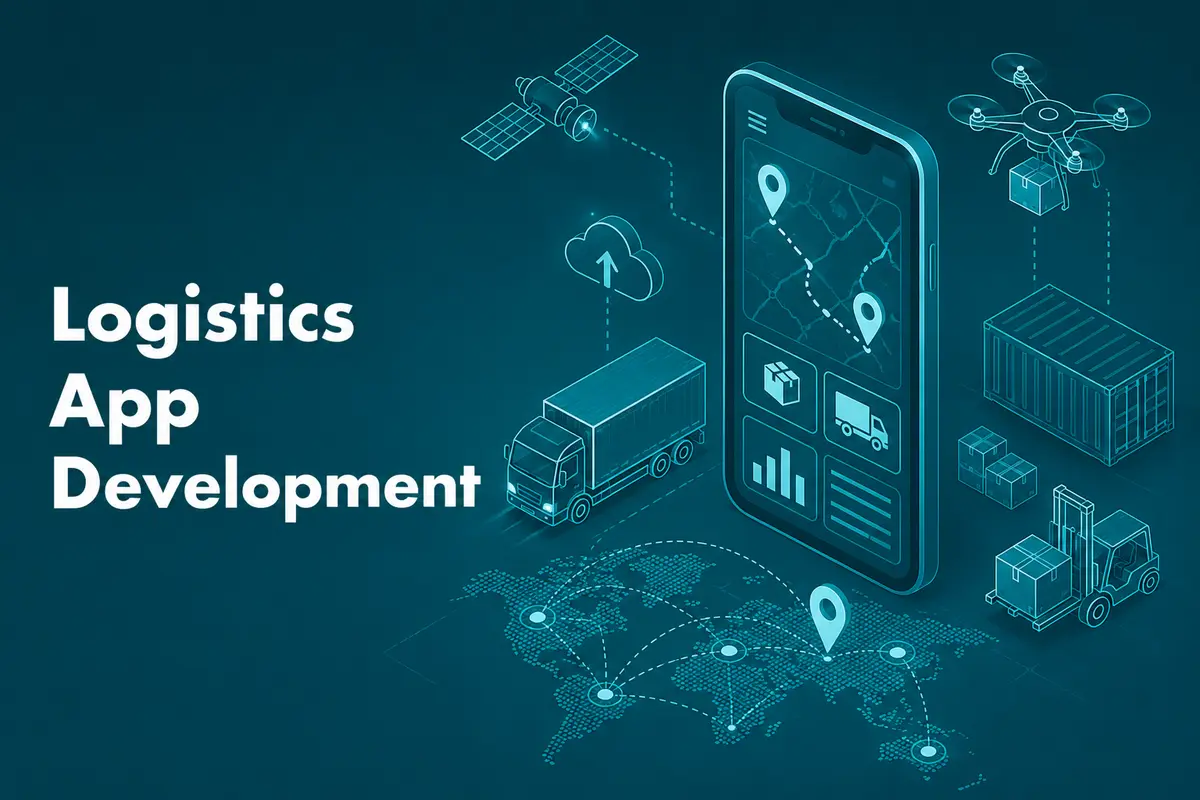
A logistics app connects the people who move goods with the people who need them to arrive on time. Building one in 2026 means combining route intelligence, real-time visibility, and automation into a single tool that a driver, a warehouse manager, and a customer can all trust.
This guide walks through who needs logistics software, what a build actually involves, and where AI genuinely changes the economics of the industry rather than just the marketing copy.
What is logistics software, and who actually needs it?
Logistics software is any application that helps a business plan, track, and manage the movement of goods. It is not limited to haulage firms. Carriers, manufacturers, retailers, and even individual couriers rely on some version of it every day.
Simply put, logistics software development contributes to the optimisation of every action required to move a shipment from A to B without anyone losing track of it along the way.
Factories and workshops use it to schedule outbound shipments. Retailers use it to promise and keep delivery windows. Carriers use it to keep a fleet running at capacity instead of half empty. Customers use it too, because a shipment they cannot see is a shipment they do not trust.
Who needs a logistics app, then? Almost anyone who ships, receives, or subcontracts freight.
Talk to our engineers if you want a clear view of where a logistics app would actually pay for itself in your business, rather than just adding another dashboard nobody opens.
Types of logistics apps worth knowing about
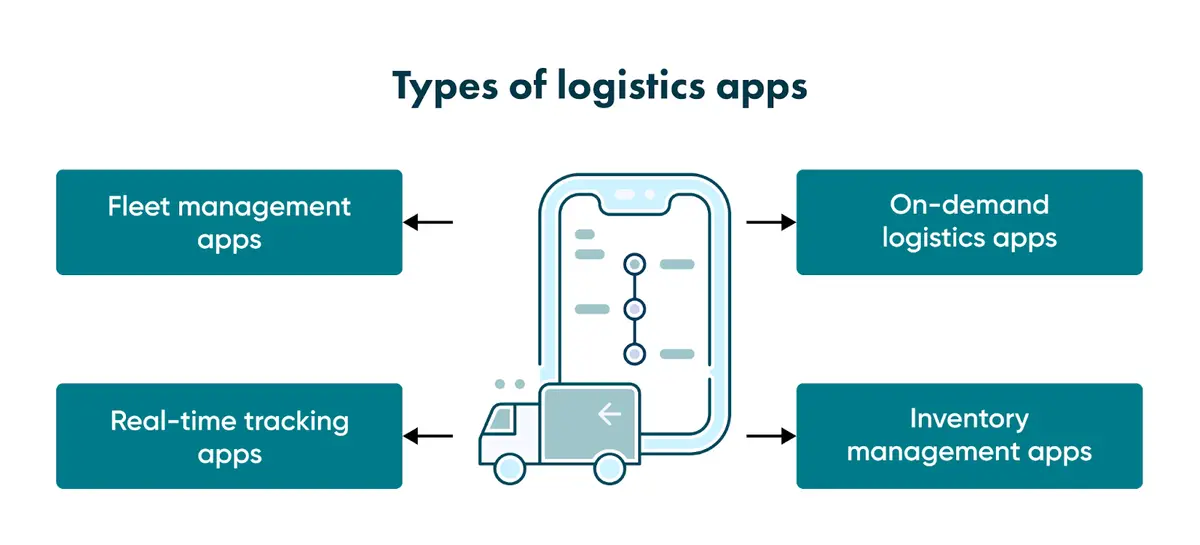
Most logistics software fits into one of four categories. Knowing which one solves your actual problem saves months of scope creep later.
Fleet management apps
Fleet management apps suit transportation companies running a fleet of vans, trucks, or buses. Dispatchers get live vehicle data: location, fuel use, maintenance status, and driver hours, updated as it happens rather than at the end of the shift.
That single dashboard view is often the first upgrade a growing fleet actually needs.
On-demand logistics apps
On-demand apps work like rideshare platforms for cargo. A customer requests a delivery, the system matches it to the nearest available driver, and both sides track progress until it lands.
Real-time tracking apps
Tracking apps give managers, drivers, and customers the same view of where a shipment actually is. This is where the technology has moved fastest. Maersk began rolling out a next-generation IoT connectivity platform across 450 vessels in 2025, upgrading from ageing 2G infrastructure to 4G so that cargo location and condition data can be updated far more frequently. The rollout is on track to finish in the first quarter of 2026. That is the direction ocean freight is heading, and mobile logistics apps for road transport are following the same logic on a smaller scale.
Inventory management apps
A single warehouse can hold hundreds of thousands of individual items. Inventory apps track the status of every one of them, from goods-in to goods-out, so nobody is relying on a spreadsheet that is already out of date by lunchtime.
Benefits of logistics applications
Good logistics software earns its cost back quickly, provided it is built around a real workflow rather than a generic template.
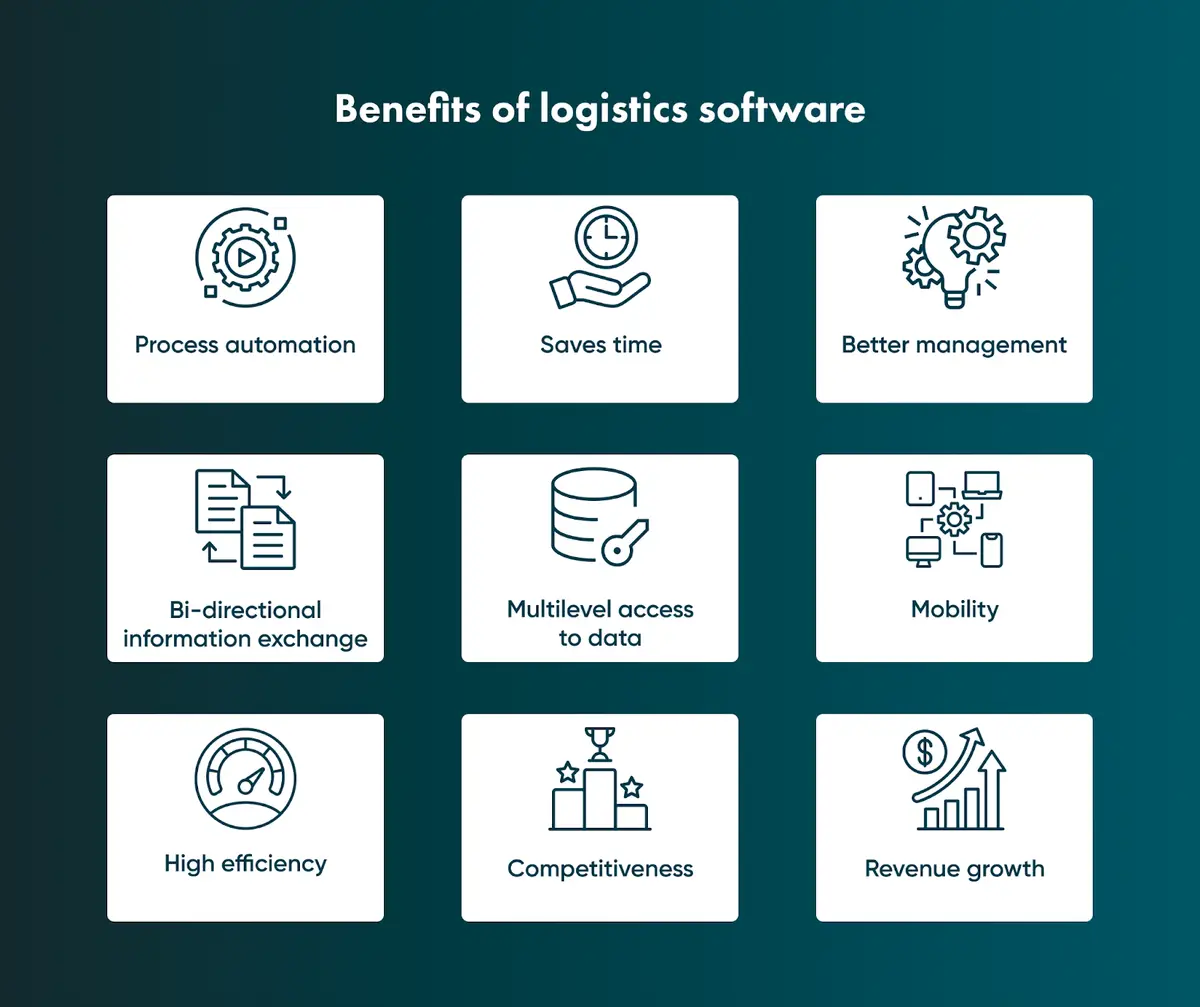
Smarter routing and lower costs. Route optimisation is where the numbers get dramatic. UPS's ORION algorithm, in continuous use since its full rollout, cuts around 100 million miles from delivery routes every year and saves the company an estimated $300 to $400 million annually in fuel and time. Few businesses operate at UPS's scale, but the underlying principle, that even small routing improvements compound across thousands of trips, applies just as well to a regional haulage firm as it does to a global carrier.
Process automation removes manual steps from dispatch, invoicing, and reporting, speeding up the operation without adding headcount. Better management follows naturally, since warehouse stock, driver schedules, and supply chain handoffs all become easier to plan once the underlying data is accurate.
Multilevel access lets a business decide exactly who sees what. A driver does not need the same view as a finance manager, and a customer should see even less. Mobility matters too: a manager travelling between depots still needs to approve a delivery exception or check a driver's location from anywhere.
A well-built app also becomes a genuine competitive edge, provided it is easy to use rather than merely functional. Put those together, and the result is revenue growth: fewer missed deliveries, more repeat customers, and a business that scales more easily.
AI and automation in logistics: what's actually live in 2026?
Is AI in logistics still mostly hype? Not any more. DHL's own 2025 trend analysis points to AI-based route planning and demand forecasting as now embedded in day-to-day operations rather than pilot projects, alongside a steady rise in warehouse robotics and IoT-linked packaging.
On paper, adding an AI layer to a logistics app sounds simple: plug in a model, get better predictions. In production, it usually means retraining models on your specific freight lanes, seasonal patterns, and customer behaviour, which takes real engineering time.
The practical 2026 use cases worth building for are predictive maintenance alerts based on vehicle sensor data, dynamic re-routing when traffic or weather changes mid-delivery, and demand forecasting that adjusts staffing and stock levels automatically. Machine learning work like this only pays off when it is trained on your own operational data, not a generic dataset.
Start with a discovery session if you want to work out which of these AI features would actually move the needle for your operation rather than just ticking a box.
Critical modules a logistics platform should contain
Do you need every module below? Almost never. Pick the ones that match your actual bottleneck and leave the rest for a later phase.
ERP system
An ERP module handles daily operational tasks such as purchasing and accounting. It can run standalone. Folding it into the main logistics app instead keeps everyone working from one source of truth, which matters more than it sounds once three departments start arguing over whose spreadsheet is correct.
Warehouse management system
This is usually the module worth building first. It tracks inventory and coordinates arrivals, picking, and dispatch across a supply chain operation that is genuinely complex and multi-stage, whatever a sales brochure might suggest. Get the warehouse management system wrong and everything downstream, from delivery estimates to customer trust, starts to slip too.
Fleet management and tracking
Coordinating a large fleet without live tracking data is guesswork with an invoice attached. This module keeps every vehicle and every shipment visible in one place.
Data analytics
A data analytics module turns daily operational noise into a clear read on productivity. A manager can compare this month against last month instead of guessing, which sounds basic until you realise how many logistics businesses still can't do it.
Primary features to plan for
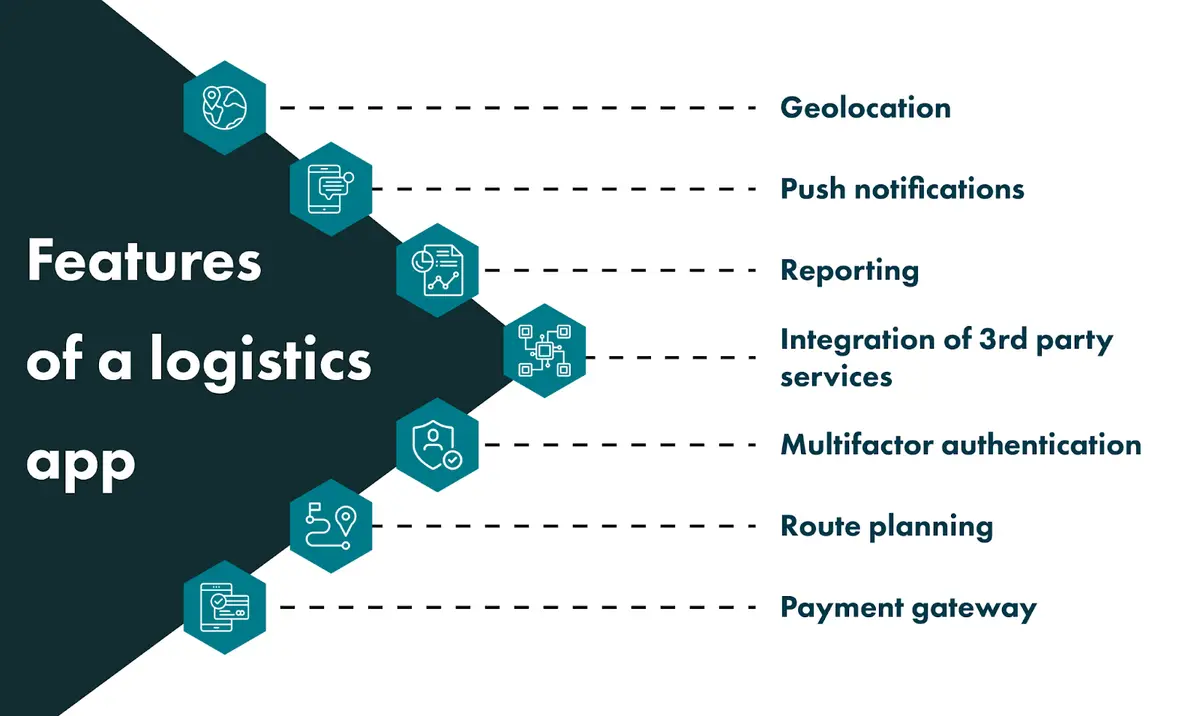
The right feature list depends on the app and the business behind it, but these come up in almost every serious build.
Geolocation
Real-time location data lets everyone (driver, manager, and customer) see exactly where a shipment sits on its route. Nobody has to phone the depot to find out any more.
Push notifications
Status changes and delays should reach the right person the moment they happen, not in a batch email at 5 pm.
Cost and delivery calculation
Clients want the price and the timeline before they commit, and this feature can be tuned precisely to your pricing model, whether that is flat-rate, distance-based, or something more complicated involving fuel surcharges.
Reporting
Detailed, searchable reports cut the time employees spend hunting for information that should already be at their fingertips.
Third-party integration and security
Linking to existing ERP and accounting systems extends the app without duplicating work that already happens elsewhere. Security comes first here, too. Multifactor authentication keeps unauthorised users out of a system that often holds commercially sensitive routing and client data, and skipping it to save a sprint is the kind of shortcut that looks fine right up until it isn't.
Route planning and payments
An integrated navigation layer builds the shortest workable route, sometimes via a specialist mapping service. Established payment gateways such as Stripe, Braintree, or PayPal let clients pay within the same app they use to track their shipment.
Building a logistics app: the step-by-step process
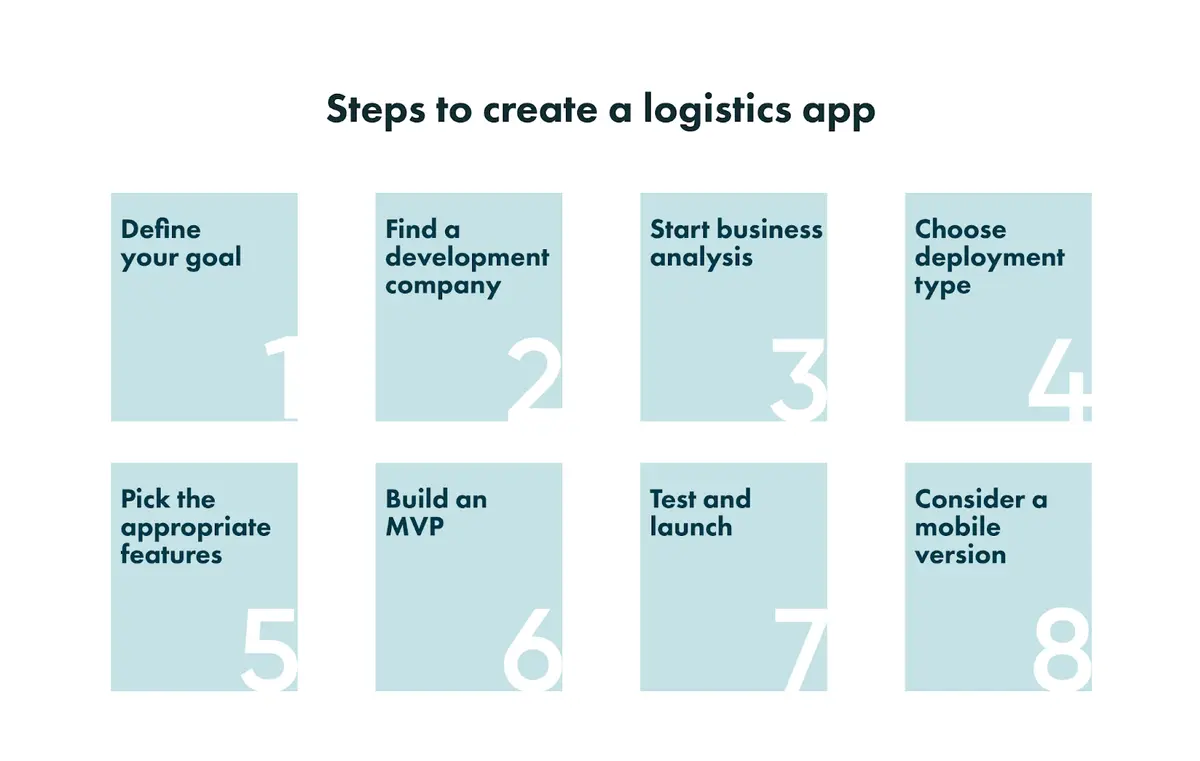
1. Map out your goals
Start by defining exactly what the app needs to do and for whom. Skipping this step is the single most common reason logistics builds run over budget.
2. Find a development partner you trust
Not every software vendor holds itself to the same standard. Checking verified reviews, such as Go Wombat's Clutch profile, and reading how outsourcing actually works is worth the hour it takes.
3. Run a discovery and business analysis phase
A proper discovery phase covers market research, risk analysis, requirements gathering, and project planning before a single line of code gets written. This is where most of the expensive mistakes get caught early instead of late.
4. Choose a deployment type
Cloud deployment is the default for most businesses today: flexible, managed by the provider, and quick to scale. On-premise still suits companies with strict data residency requirements, and hybrid setups split the difference.
5. Select the features that matter
Work with your development team to choose features against your actual goals. Adding features nobody uses is the quickest way to inflate both the budget and the timeline.
6. Build an MVP
Most timelines quote a few weeks for an MVP. In practice, scope creep is the variable that decides whether that holds. An MVP tests the core idea with a working, minimal version before you commit to the full build. It is the cheapest way to find out whether an assumption was wrong.
7. Test properly before launch
Skip this step, and you will hear about it from a driver stranded with a broken app, not from a bug report. Every version, MVP or full release, needs proper QA testing before it reaches a driver or a customer.
8. Make it mobile-friendly from day one
A cross-platform mobile app for iOS and Android is no longer optional. Most drivers, and a growing share of customers, expect the mobile experience to match the desktop one exactly.
Key takeaways
Logistics app development in 2026 is less about chasing the newest feature and more about building the right modules for your actual bottleneck. Real-time tracking, AI-assisted routing, and solid warehouse data all earn their cost back, but only when they are built around how your business actually moves goods.
Start with the bottleneck that costs you the most today. Everything else can follow in later phases.
Frequently asked questions
What is logistics software?
Logistics software is any application that helps a business plan, track, and manage the movement of goods, from a single delivery app to a full warehouse and fleet management platform.
How do you develop a logistics app?
The process runs from goal-setting and choosing a development partner through discovery, deployment planning, feature selection, MVP testing, and full QA before launch. Most builds take several months, depending on the scope.
How much does a logistics app cost to build?
Cost depends heavily on features and integrations. An MVP with core tracking and dispatch functionality costs far less than a full platform with ERP, AI-driven routing, and multi-region deployment.
How is AI actually used in logistics in 2026?
Predictive maintenance, dynamic re-routing, and demand forecasting are the three uses seeing real production deployment right now, rather than staying stuck at the pilot stage.
Do you need an MVP before building the full app?
Not always, but it is the cheaper route if there is any uncertainty about which features matter most. An MVP tests the core assumption before the full budget is committed.
What's the difference between a logistics app and a full transportation management system?
A logistics app usually solves one or two specific problems, such as tracking or dispatch. A transportation management system (TMS) is broader, covering planning, execution, and settlement across an entire freight operation.
Share and subscribe to our blog
Related articles

Project Discovery Phase in Software Development
What are the important elements of a discovery phase and how important is it for a project? According to Statista, 48% of software projects fail due to poorly documented requirements and tasks. Therefore, it is essential to elaborate on al…

How to Outsource
Outsourcing: the benefits and risks Outsourcing in business is a way to work remotely with experienced development companies to turn your idea into real, fully functional software. As a result, you can save resources and delegate critical…

Why Is the Digital Twin of an Oil Refinery the Most Complex AI System You Will Ever Build?
Building a digital twin of an oil refinery isn't a platform-selection problem — it's a physics, data, and integration problem stacked seven layers deep. From thermodynamics and sensor fusion to safety-critical control system integration, each layer depends on the one beneath it, and most failed projects trace back to programme design, not technology choice. This piece breaks down what actually makes refinery digital twins so hard to get right, with real deployment data from Cosmo Oil and Dangote showing what a well-scoped project looks like in practice.

How can we help you ?