



What Role Does Big Data Play in Software Development?

By 2025, the world's data volume had reached roughly 181 zettabytes, and IDC expects that figure to pass 700 zettabytes before the decade is out. That scale is what people mean by “Big Data”: not just more information, but so much that traditional tools and traditional thinking stop working.
For software teams, Big Data analytics is no longer a specialist add-on. It shapes what gets built, how fast it ships, and whether it holds up once real users touch it. This article covers what Big Data is, how it fits into software development, and what has changed heading into 2026.
What is Big Data?
Big Data refers to datasets so large and varied that they need purpose-built technology to store, process, and analyse. Sources range from the Internet of Things (IoT) to social media, sensor networks, financial systems, and internal business databases, most of which end up in cloud storage, commonly called a data lake.
Big Data analytics works across structured and unstructured data, and it now touches nearly every sector, including security, healthcare diagnosis and prevention, retail, ecommerce, and marketing. In business, it helps predict customer behaviour, tighten manufacturing processes, assess creditworthiness, and lift employee productivity. For the fundamentals, see our earlier piece on Big Data applications.
A software development company that understands Big Data does more than store information. It builds Big Data software that turns raw signals into decisions, which is the discipline Go Wombat applies to every custom software development project involving large-scale data.
How Big Data works: its types
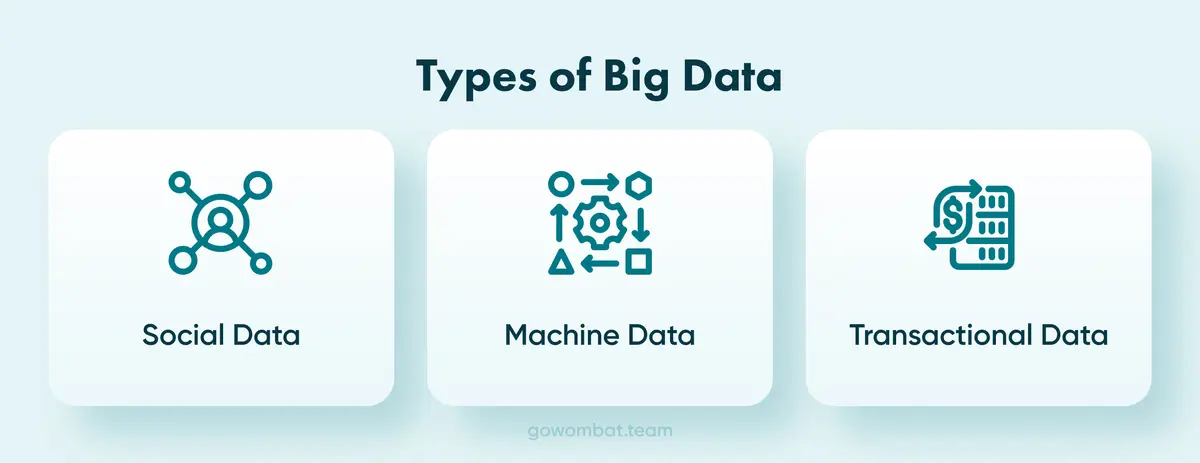
Big Data comes from three broad sources: social, machine, and transactional. Splitting it this way makes a genuinely overwhelming subject easier to reason about.
Social Big Data
This covers everything a person does online: shopping, messaging, uploading photos, and browsing. The pace has only accelerated since this article was last updated.
Social Big Data also includes the internet of behaviour (IoB), plus city-level statistics, movement data, and medical records. The list is long, and it keeps growing.
Machine Big Data
Despite the name, this has nothing to do with machine learning itself. It means data generated by machines, sensors, and IoT devices: smartphones, smart home systems, security cameras, weather satellites, and industrial equipment.
Toyota Motor North America shows what this looks like in production. The company connected 200-plus CNC machines per site to AWS IoT SiteWise and layered Amazon Lookout for Equipment on top to flag anomalies before a breakdown. Operational availability rose from 78-82 per cent to 92 per cent, and monthly downtime fell from roughly 40 hours to 20: sensor noise turned into a maintenance decision before the machine stops, a pattern spreading fast across manufacturing plants.
Transactional data
This mostly concerns the financial sector: fund transfers, purchases, ATM operations, the kind of workload at the core of most fintech software. Modern systems give instant access to these massifs, stored in dedicated data centres, often alongside a Hadoop-based file system for large-scale computing jobs.
If this is the kind of workload you are building, share your project brief with our engineers.
How we analyse Big Data
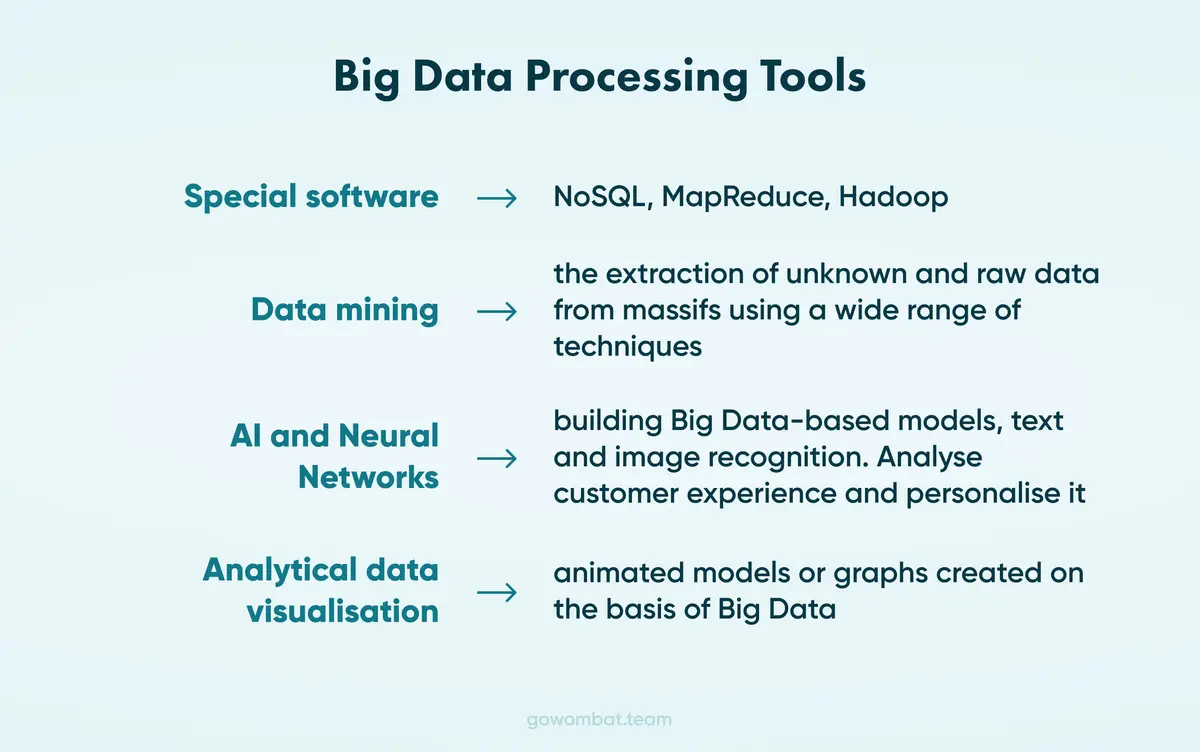
An Excel spreadsheet cannot hold a genuine Big Data massif, so purpose-built software is not optional. Grid computing and in-memory analytics now let companies process almost any volume of data, and increasingly that processing feeds directly into AI workflows rather than sitting apart from them.
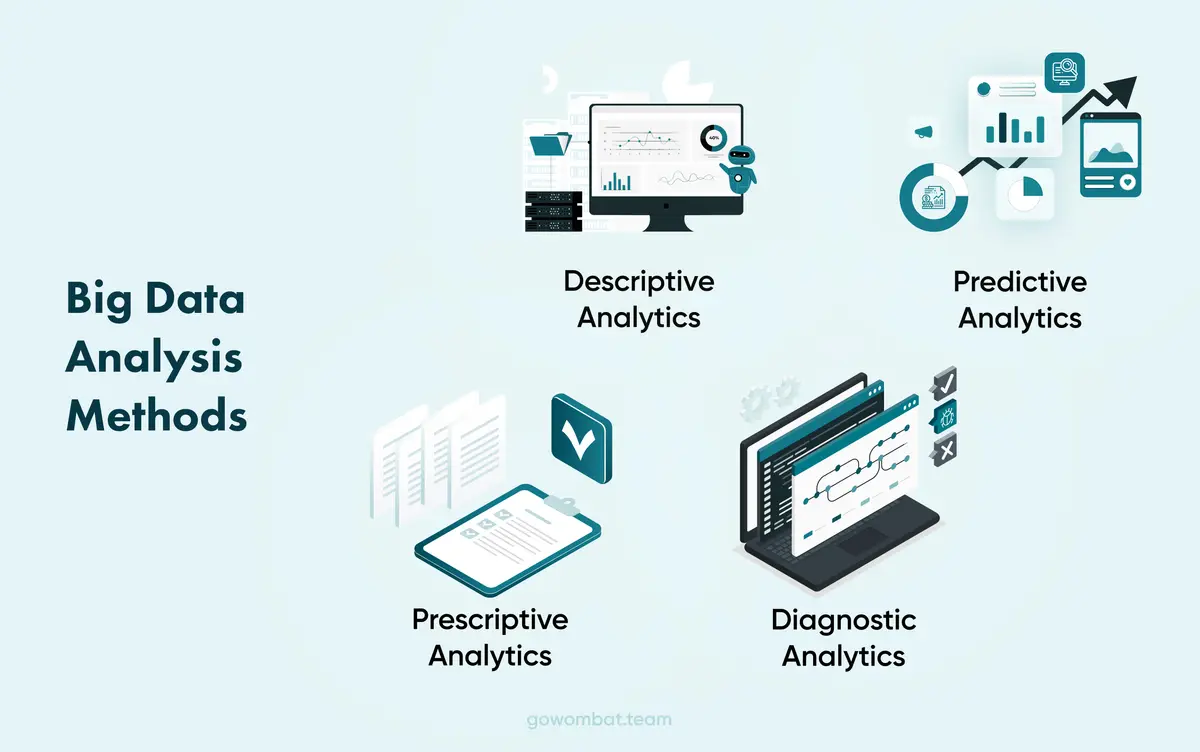
Four methods cover most of what businesses actually do with Big Data analytics. So which of the four matters most for your team?
Descriptive analytics
The most common method. It answers “what happened” using real-time data and conventional mathematics, the kind behind sociological research or the web statistics your team pulls from Google Analytics.
Diagnostic analytics
Diagnostic analytics asks why something happened, hunting for anomalies and connections between events that would not be obvious from raw numbers alone, the way Amazon analyses sales and profit data to explain a revenue miss.
Predictive analytics
Predictive analytics uses templates built from similar past events to forecast what happens next. It can flag a probable market crash, model a share price move, or assess whether a borrower is likely to repay a loan.
Prescriptive analytics
This is where Big Data stops describing the problem and starts recommending the fix. Prescriptive models flag weak points in a process, similar to how Toyota's team decided when and how to intervene rather than just knowing a fault was coming.
How is Big Data used in software development?
Building a Big Data-aware software project means studying everything from consumer preferences through to how real users behave inside your product. That is a genuine advantage. You get to build what people need instead of guessing.
Three things tend to come out of this work.
Expectations of users
Big Data analytics tells you what your audience is actually looking for, and what functionality is missing from what already exists. From there, you can work out a feature's real business value before committing engineering time to it.
How software is used
Usage data shows whether people understand what a feature is for, where they get stuck, and which features nobody touches. Big Data, used well, sharpens the user experience without relying on guesswork.
The faster go-to-market process
Accurate data management gets a product to market faster, because the team builds against evidence rather than assumptions. Curious what this could look like for your own roadmap? Map your next sprint with us.
Big Data in agile development
Agile remains the dominant software development method, and Big Data has quietly become one of its more useful companions. Cloud-based analytics and distributed processing tools let development teams test and validate what they built inside a single sprint, rather than waiting for a retrospective months later.
That shifted again heading into 2026. At Databricks' Data + AI Summit in June 2026, the company introduced Genie One and a new Unity AI Gateway, alongside LTAP, an architecture that lets transactional and analytical workloads read and write the same copy of data instead of syncing separate copies through ETL pipelines, for a development team that closes the gap between what the data shows and what the sprint delivers.
Fewer stale dashboards. Fewer decisions were made on last week's numbers.
Developers can now analyse results mid-sprint and see immediately what worked and what needs another pass. It saves time and reduces risk because the team stops relying on a deadline and a guess.
Advantages of Big Data: why your software should apply it
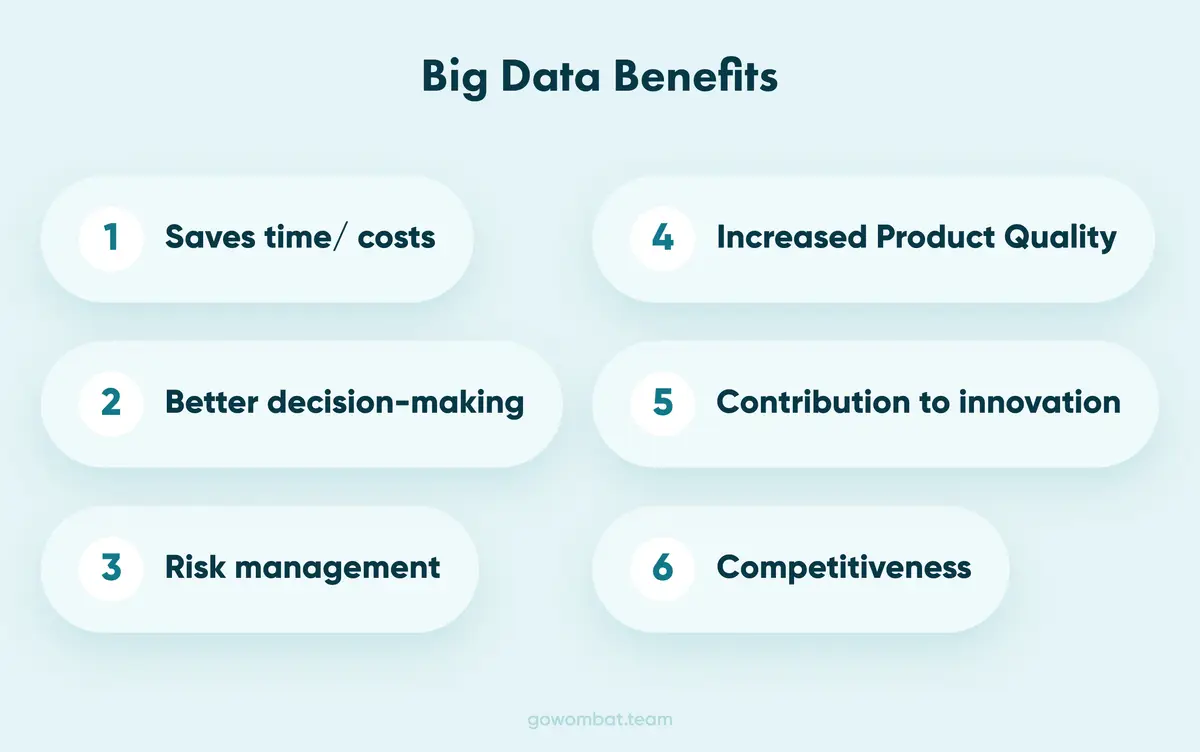
Saves time and costs
Big Data analytics surfaces the problem areas above, explains why they exist, and helps you automate and restructure business processes to lift revenue and win over prospective clients.
Risk management
Predictive analytics gives you an early view of the risks heading your way, and shows what problems competitors are already hitting, a cheap way to avoid repeating their mistakes.
Better decision-making
Traditional analysis cannot compete with Big Data analytics software once volume and speed matter. Businesses act on evidence rather than assumptions, responding to market shifts with more confidence and less delay. Work that once took weeks of manual reporting can now be finished in hours.
Increased product quality
Understanding what customers want, drawn directly from their own data, helps you build products people actually want to use and recommend.
Contribution to innovation
Research and development grounded in Big Data analytics surfaces the innovation customers already expect, rather than the kind of roadmap a roadmap assumes they want.
Stay competitive
Big Data analytics gives you early visibility into where an industry is heading, plus a clearer read on how customers actually buy, not just what they say they want.
Pitfalls to consider: what challenges remain
There are two sides to this. Here is where things tend to go wrong.
Lack of specialists
The shortage of data analysts and data scientists remains one of the biggest constraints on Big Data software development. A software engineer skilled in mobile or web development is not automatically equipped for Big Data, AI, and machine learning work, and that gap makes good specialists hard to hire.
This is not a constraint at Go Wombat. Our data scientists work inside delivery teams, not as an outside consultancy bolted on afterwards.
Security
Data collected for analytics is often sensitive, sometimes deeply personal, which makes security non-negotiable. Poor security leads to breaches, and a large dataset is an obvious target for anyone looking for one.
Go Wombat's certified Chief Information Security Officer protects every Big Data system we build, with security treated as a design requirement, not an afterthought.
Compliance
Compliance sits next to security, and the stakes have only grown. In May 2025, Ireland's Data Protection Commission fined TikTok €530 million for unlawfully transferring EEA user data to China and for GDPR transparency failures. That is what happens when Big Data compliance gets treated as paperwork rather than architecture.
GDPR remains the clearest regulation your business needs to satisfy if it operates in the EU. Go Wombat's CISO also holds Data Protection Officer certification and leads GDPR compliance work on every relevant project.
Why working with Go Wombat helps with Big Data
Go Wombat delivers software development and consulting, and we would rather help you pick the right approach than sell you the biggest one. Our specialists explore your data, find methods that actually fit your business, and build in security and compliance from day one.
Choosing a Big Data software development company is not a decision to make on price alone. Look for a team that can show real project history, not just a claim of expertise, and ask to see the business intelligence and data visualisation work behind their pitch.
Key takeaways
Big Data has stopped being an optional layer bolted onto software after launch. In 2026, with AI-augmented platforms unifying analytical and transactional data in real time, it behaves closer to infrastructure than a feature. Teams that treat it that way ship faster, decide with more confidence, and spend less time firefighting problems they could have seen coming.
The risk lies in treating Big Data as a checkbox: collected but unused, secured on paper but not in practice. Toyota's maintenance gains and TikTok's compliance bill point at the same lesson, from opposite ends.
Frequently asked questions
What technologies are used in Big Data projects?
Big Data projects typically combine Apache Spark and Hadoop for large-scale processing, Kafka for real-time streaming, and a cloud platform such as AWS, Azure, or Google Cloud for storage and compute. Databricks and Snowflake now unify analytics and AI workloads, while Python and SQL remain standard for data manipulation.
What's the difference between Big Data and traditional analytics?
Traditional analytics works with smaller, structured datasets and answers predefined questions. Big Data analytics handles far larger, messier data, often unstructured, from IoT sensors, social platforms, logs, and transactions, relying on distributed systems to find patterns that conventional tools were never built to process.
How can Big Data reduce business risks?
Big Data lets companies catch risk earlier by analysing historical and real-time information together. Predictive models can flag anomalies, anticipate operational failures, or catch fraud before it escalates, the way Toyota's system flags equipment failure days ahead of the fault itself.
How does Big Data support agile development?
Big Data gives agile teams continuous feedback on how a feature performs once it ships, not just how it was expected to. That lets teams validate assumptions inside a sprint and release with less guesswork built into the plan.
How is AI changing Big Data analytics in 2026?
AI-native platforms, including the tools shown at Databricks' 2026 summit, are collapsing the old separation between storing data and analysing it. Agents now query and act on data where it already lives, cutting the lag between an event and a decision.
How do companies ensure Big Data security and compliance?
Companies secure Big Data systems with encryption, strict access controls, and continuous monitoring. Compliance requires documented data governance covering collection, processing, and storage, alongside regional rules such as GDPR and clear retention limits.
Turn your data problem into a scoped project
See our ListAcross case study and explore our business intelligence and data visualisation services.
Tell us which data sources you use, where reporting or integration breaks down, and who needs the result. Discuss your data project with our team so we can understand the scope and the next step.
Share and subscribe to our blog
Related articles

Big Data - A brief introduction and The Top 5 Applications
Some of the hidden details of Big Data and which industries are the biggest users Big data initially gained attention as an instrument for better understanding and organising existing data. With technical progress, the idea of big data usa…

Cloud Data Security: Protecting Sensitive Data
Transferring corporate data to the cloud allows organisations to increase their flexibility, scalability, and cost efficiency. Cloud computing has become an essential part of modern corporate infrastructure, enabling remote work, real time…

Big Data in the Hospitality Industry
Our recent articles about changes in the hospitality industry show that digital technologies revolutionise the industry and create new opportunities for business owners to gain profit and provide customers with top level service quality. B…

What is AdTech? A look at its influence on industries
A look at Examples, Trends, and Dealing With Privacy Issues affecting all industries Modern emerging technologies contribute to a deep analysis of many types of business, taking them to a new level. Advertising technology, or AdTech, is on…

How can we help you ?